Subnautica is our recommendation for solo players who want discovery to give survival a purpose. The Long Dark is the stronger choice for a harsh, quiet wilderness, while Don’t Starve Together suits a group willing to learn through failure. Survival games differ most in what they demand repeatedly. Gathering food can be a satisfying routine or an interruption, so choose the pressure you want rather than the longest crafting list.
Editorial illustration, not a game screenshot.
Four survival games with clear identities
- Subnautica. Subnautica uses equipment and vehicles to turn an initially intimidating ocean into an increasingly readable place. Choose it when finding a new biome matters as much as improving a base. It is a solo adventure, and its deeper waters can remain unsettling even when you understand the survival systems.
- The Long Dark. The Long Dark makes warmth, fatigue and supplies part of every journey. Its survival sandbox is about staying alive rather than following a single sequence of missions. Choose it for deliberate resource decisions and isolation; its quiet landscape should not be confused with a forgiving walking tour.
- Don’t Starve Together. This standalone multiplayer game gives friends a reason to divide work and share discoveries. Its strange world rewards preparing for what comes next, not merely filling a hunger meter today. Agree whether the group wants experimentation or outside guidance, because those expectations produce very different shared evenings.
- Minecraft. Minecraft suits players who want survival to support a project they invent themselves. Gathering materials can lead to a house, transport network or elaborate construction rather than a fixed ending. Creative Mode changes that relationship by removing resource constraints, so choose the mode that matches the activity you actually enjoy.
Compare the choices
| Game | Main appeal | Trade-off |
|---|---|---|
| Subnautica | Underwater discovery and a central mystery | Depth and oxygen create anxiety |
| The Long Dark | Solo wilderness decisions | Weather can defeat an ambitious plan |
| Don’t Starve Together | Cooperative learning and seasonal preparation | Consequences can punish an unprepared group |
| Minecraft | Building within a survival world | Structure depends on your own goals |
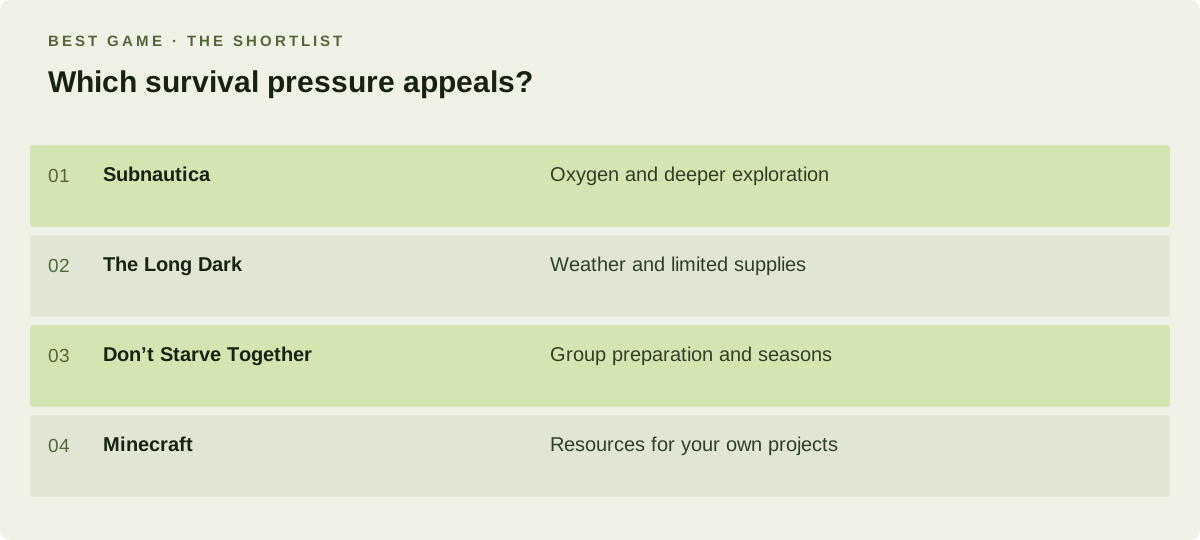
Which survival pressure appeals?. Comparison by play preference, not a numerical score.
Tune the routine before committing
Modes matter. In Subnautica, Freedom removes hunger and thirst while oxygen still matters; Creative removes more constraints. The Long Dark offers different survival experiences and custom settings. Adjust the pressure deliberately instead of assuming a default setting is the only legitimate way to explore. Removing a routine you dislike can reveal the part of a game you wanted all along.
For cooperative games, check compatible platforms, versions and hosting arrangements before inviting friends. A shared world also benefits from a simple agreement about whether other players can advance major goals while someone is away. Open-world games can offer exploration without constant upkeep, while cozy games may better suit an evening focused on making a place comfortable. Survival should create worthwhile decisions rather than a schedule of chores you resent.