No short list can settle the best games of all time. The answer changes with the activity you value, the hardware you can use and the amount of time you want to invest. A useful shortlist should explain why a game still deserves your attention rather than turn inherited reputation into an instruction. These four picks represent different strengths: teaching a puzzle language, rewarding curiosity, enabling role-playing choices and making a simple rule set endlessly expressive. Each offers a different reason to keep playing.
Editorial illustration, not a game screenshot.
Which game should you choose?
- Portal 2: Choose it for the elegance of learning a small set of tools and discovering increasingly surprising uses for them. Its humour and pacing give the solo puzzles a memorable context. It is a finite campaign, and knowing the solutions changes a replay. The separate cooperative campaign is another attraction, but it should not be confused with replaying the same story together.
- The Legend of Zelda: Breath of the Wild: Choose it for exploration driven by what you notice and want to investigate. Its landscape and interacting systems encourage trying an idea instead of waiting for an explicit instruction. Weapons breaking, exposed travel and a lightly directed structure can frustrate players who prefer stable equipment and a clear route. Choose it for curiosity, not completion-list comfort.
- Baldur’s Gate 3: Choose it for the interplay between conversations, party abilities and tactical encounters. It gives choices practical consequences and allows different characters to approach the same situation in meaningfully different ways. Its length and systems make it a major commitment. You do not need to optimise every character or reload every imperfect result to have a worthwhile campaign.
- Tetris Effect: Connected: Choose it as a modern way to experience the enduring pleasure of arranging falling blocks. Music and visual response make familiar decisions feel connected to a larger performance. This recommendation is for Effect: Connected, not a claim that every edition of Tetris has the same modes. Falling-block speed and intense effects may also be uncomfortable for some players.
| Game | Best fit | Main consideration |
|---|---|---|
| Portal 2 | Teaching through puzzle design | Finite first-time discovery |
| The Legend of Zelda: Breath of the Wild | Self-directed exploration | Equipment and navigation friction |
| Baldur’s Gate 3 | Role-playing agency | Time and system complexity |
| Tetris Effect: Connected | Expressive arcade puzzle play | Edition and sensory intensity |
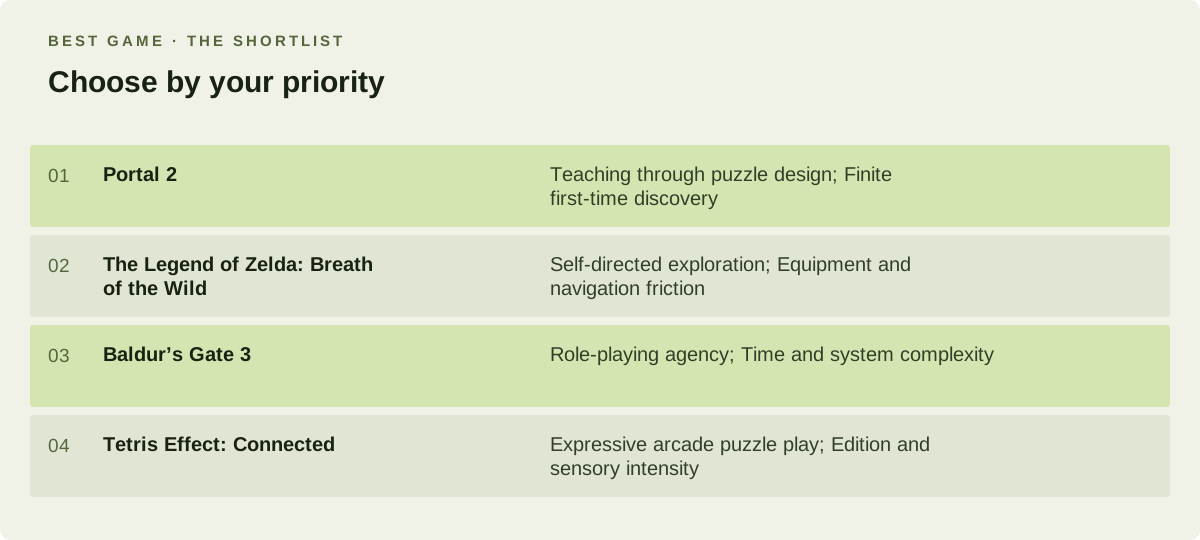
Choose by your priority. Comparison by play preference, not a numerical score.
What matters before you start?
All-time rankings often mix historical influence, personal affection and present-day playability without saying which is being judged. Those criteria can point towards different games. Here the priority is a compelling activity you can still seek out, with limitations stated beside the recommendation. Check the exact available edition and supported hardware before purchasing an older title or a newer port. A remake may change systems as well as visuals. Review aggregates can reveal critical reception, but a score cannot tell you whether you enjoy navigating without markers or making tactical decisions in dialogue-heavy adventures.
Make the choice fit your routine
Begin with the game whose central verb appeals most: solve, explore, role-play or arrange. Single-player games are easiest to fit around your own schedule, but a finite campaign and an open-ended world make different demands. Open-world games suit curiosity more than a desire to clear a tightly directed sequence. Among Zelda games, Breath of the Wild is the choice for setting your own route rather than following a traditional dungeon order. Treat the list as an invitation to find an enjoyable evening, not as homework or a catalogue of experiences you must complete.