
A space setting can be a destination, a workplace or a problem to solve. One player wants to land on an unfamiliar planet; another wants to understand an orbit or negotiate with an alien empire. These four space games separate those intentions. The selection includes exploration, piloting and grand strategy, with clear limits on what each provides. None is recommended merely because its galaxy is large: the important question is what you actually do there.

Editorial illustration, not a game screenshot.
Which games should you choose?
- Outer Wilds: Choose it for an interconnected mystery whose discoveries change your understanding of a small solar system. Learning how places and events relate is the main form of progress, making observation unusually valuable. Read as little as possible beforehand. Detailed solutions can remove discoveries that cannot be made new again.
- No Man’s Sky: Choose it for open-ended planetary travel, gathering and building. It suits players who enjoy setting their own objectives and returning to a universe without needing a tightly directed story each evening. Procedural variety does not guarantee handcrafted narrative surprises on every planet; expect recurring activities alongside unusual landscapes.
- Elite Dangerous: Choose it for the feeling of operating a starship. Trading, mining and combat provide different ways to inhabit the cockpit, with travel itself forming a meaningful part of the experience. Its interface and long journeys need patience; check the current PC offering and do not assume console feature parity.
- Stellaris: Choose it for an alien civilization rather than an individual pilot. Exploration leads into diplomacy, development and conflict, with the galaxy viewed as a network of political and economic decisions. It is grand strategy, not a flight simulator, and expansions can complicate the content choice.
Compare the main differences
| Game | Best fit | Main consideration |
|---|---|---|
| Outer Wilds | Knowledge and cosmic mystery | Sensitive to spoilers |
| No Man’s Sky | Planetary exploration and building | Self-directed goals and repeated tasks |
| Elite Dangerous | Piloting and a spacefaring career | Learning curve and travel time |
| Stellaris | Civilizations and galactic politics | Large strategic systems to learn |
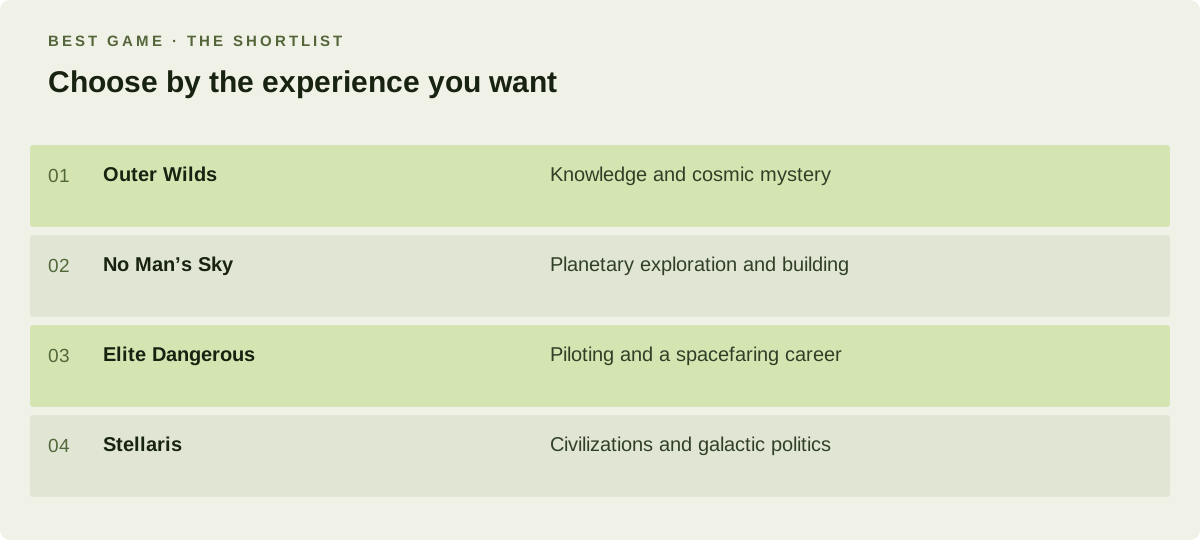
Choose by the experience you want. Comparison by play preference, not a numerical score.
Choose your scale before your starship
Outer Wilds is the strongest fit for a finite mystery and a sense of discovery. No Man’s Sky is better for a continuing personal project. Elite Dangerous makes the vehicle and the working pilot central, whereas Stellaris makes entire populations and borders your responsibility. These differences matter more than whether a game calls itself an open world.
If you want realistic spacecraft construction, Kerbal Space Program belongs on a different shortlist from combat-oriented starship games. Likewise, players seeking story-driven RPGs may prefer companions and scripted decisions over open-ended travel. Before investing in a long campaign, decide whether your ideal evening is one meaningful discovery, one practical delivery or a series of empire decisions. Choosing that scale makes it easier to enjoy space without mistaking size for depth.