
Couch co-op works best when everyone can understand what is happening on the same display. That may mean split-screen, a shared camera or a second player with a deliberately smaller role. Those arrangements produce very different evenings, even when every box says local co-op. This shortlist focuses on cooperation rather than simply listing party games where you compete. It includes a demanding kitchen, a two-person adventure and a quieter shared journey. Choose around the number of people actually sitting down and their confidence with a controller.

Editorial illustration, not a game screenshot.
Which game should you choose?
- Overcooked! 2: Choose it for an energetic group willing to coordinate jobs and recover from mistakes. Shared kitchens turn simple actions into problems of communication, timing and knowing who is responsible for the next plate. Its deadlines can be stressful. Rotate jobs, make short plans before retrying and avoid treating the least experienced player as the source of every problem.
- It Takes Two: Choose it for exactly two people who want a sustained adventure. Constantly changing mechanics give both participants new responsibilities instead of assigning one person a permanent supporting role. It cannot be played as a normal solo campaign. Its relationship themes and challenging sections may also fit some pairs better than a supposedly universal family recommendation suggests.
- Spiritfarer: Farewell Edition: Choose it for a gentler shared routine, with a second player joining as Daffodil while the main journey follows Stella. Managing the boat and helping its passengers creates space for conversation. The roles are not identical and the story deals with death and farewell. Check that both the supporting role and the subject matter suit your partner.
- Portal 2: Choose it for a dedicated puzzle campaign where two sets of portals create useful possibilities. Talking through a chamber together is the central activity rather than an interruption to the action. Confirm local split-screen support on your chosen edition and hardware. Reading the scene on a divided screen can also be harder from a distant sofa.
| Game | Best fit | Main consideration |
|---|---|---|
| Overcooked! 2 | A lively shared kitchen | Timers create pressure |
| It Takes Two | An equal two-person adventure | Two players required |
| Spiritfarer: Farewell Edition | Companionship and boat routines | Unequal roles and bereavement themes |
| Portal 2 | Two-player spatial puzzles | Edition and viewing distance |
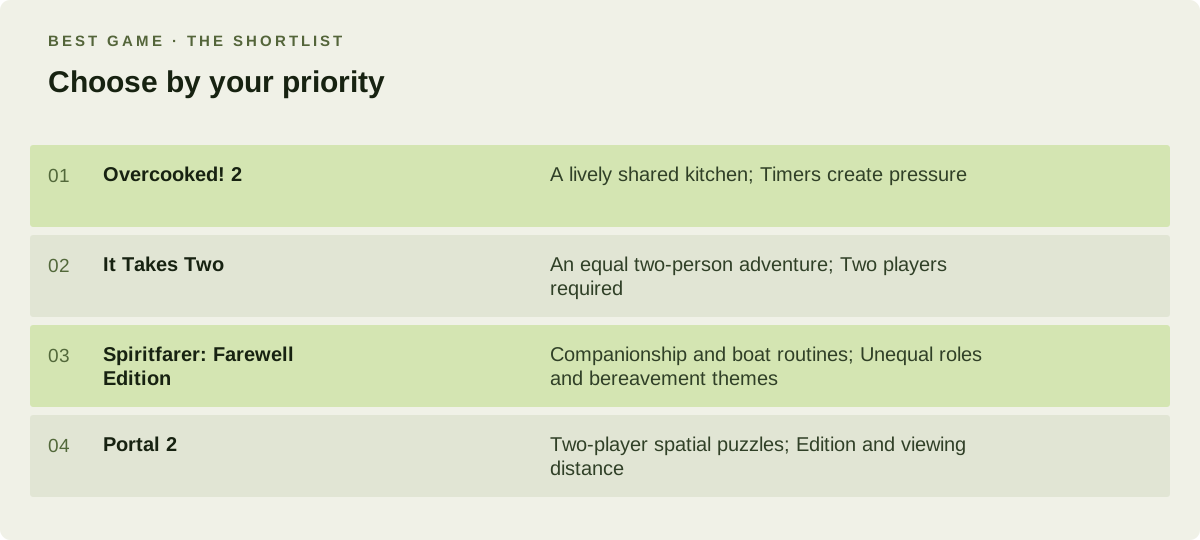
Choose by your priority. Comparison by play preference, not a numerical score.
What matters before you start?
Check local support on the exact platform listing; a game offering online co-op does not necessarily allow a second controller on one machine.
Confirm controller compatibility, player count and whether additional accounts are needed. Set up the room before the guests arrive and launch the intended local mode once. If someone is new to games, explain the few controls they need immediately instead of delivering every possible instruction. A shared screen makes coaching easy, but taking over the controller whenever something goes wrong removes their chance to learn.
Make the choice fit your routine
For an equal partnership, It Takes Two or Portal 2 makes the clearest starting point. Choose Overcooked! 2 when the group wants cheerful pressure, and Spiritfarer when quiet cooperation matters more than equal responsibility. Two-player games are not interchangeable with larger party sessions: a four-person gathering needs an appropriate player limit. Co-op games also vary in how much progress they save between evenings. Decide whether this is a one-night activity or a campaign you will arrange to continue. That simple agreement prevents a promising shared adventure from becoming a save nobody can coordinate.