A long campaign is easier to commit to when you enjoy what happens in its ordinary battles. The strongest 3DS RPGs offer very different answers: bank actions for a decisive turn, recruit an enemy into your party, or move an army around a grid. These recommendations separate those systems instead of treating every role-playing game as interchangeable. They also distinguish a comfortable traditional adventure from a game that expects experimentation and occasional failure.
Editorial illustration, not a game screenshot.
3DS RPGs with different battle systems
- Bravely Default: Combining character jobs lets you build a party around an idea rather than a fixed set of roles. Banking turns with Default and spending them with Brave makes timing an important part of even familiar encounters. Later sections repeat material, which can interrupt the initial momentum.
- Shin Megami Tensei IV: Demon recruitment and fusion keep the party changing. Exploiting elemental weaknesses creates extra opportunities, but enemies can turn the same logic against you, making preparation more important than relying on a favorite creature. Its opening can be punishing, and the tone is darker than most Nintendo RPGs.
- Fire Emblem Awakening: This is the tactical choice: weapon matchups, paired characters and positioning matter across an entire battlefield. Conversations give the soldiers personality, making the consequences of a poor decision feel more meaningful. Choose Casual mode if permanent losses would prevent you enjoying the campaign.
- Dragon Quest VIII: Journey of the Cursed King: A colorful travelling party and traditional turn-based fights make this an accessible long-form adventure. Visible enemies on the 3DS version help you decide when to engage instead of constantly being interrupted while exploring. The deliberate pacing suits patient players more than those seeking rapid combat.
- Radiant Historia: Perfect Chronology: Moving between branching timelines turns story progress into a problem-solving exercise. Its battle grid also rewards pushing enemies together, so clever positioning can be as valuable as choosing the strongest individual attack. This is the expanded 3DS release, distinct from the original DS cartridge.
Compare the games at a glance
| Game | Best fit | Main consideration |
|---|---|---|
| Bravely Default | Job-system experimentation | Late-game repetition |
| Shin Megami Tensei IV | Demanding demon building | Difficult opening |
| Fire Emblem Awakening | Grid-based tactical battles | Not a conventional dungeon RPG |
| Dragon Quest VIII: Journey of the Cursed King | Traditional party adventure | A substantial time commitment |
| Radiant Historia: Perfect Chronology | Timeline story and positioning | Read the edition name carefully |
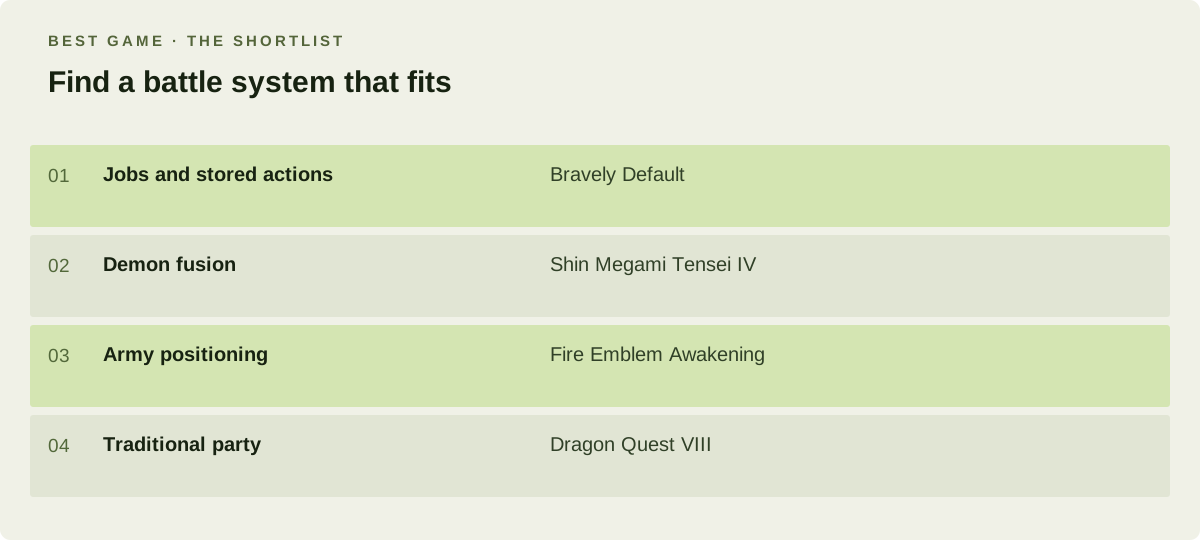
Find a battle system that fits. Comparison by play preference, not a numerical score.
How to choose without buying twice
Bravely Default is the clearest starting point if you want to customize roles without losing the familiar rhythm of towns, dungeons and bosses. Dragon Quest VIII offers a steadier journey with less pressure to reinvent a party. Choose Shin Megami Tensei IV when overcoming a difficult encounter is the attraction, or Awakening when you prefer strategy games built around terrain and units. Radiant Historia suits readers who enjoy revisiting events with new information rather than exploring one continuous landscape.
Original 3DS RPG cartridges vary substantially in language and regional compatibility. Check the exact edition and console region, especially for Atlus releases and imports. The end of new 3DS eShop purchases means a listing should not promise that you can buy missing DLC later. These campaigns stand on their core single-player content. Players wanting newer hardware have a separate pool of Switch RPGs, while DS RPGs include the earlier Radiant Historia and other distinctive dual-screen designs.