
Civilization VI is our recommendation for players who want time to consider a long-term plan. Age of Empires II: Definitive Edition is the alternative if managing an economy while responding to an opponent sounds exciting. Strategy games cover several different mental activities, from arranging a single turn to sustaining an empire. The best introduction is the one whose basic decisions interest you enough to survive the first few mistakes.

Editorial illustration, not a game screenshot.
Four useful strategy starting points
- Civilization VI. Choose Civilization when you want to look at terrain and imagine what it could become over a campaign. District placement makes a city’s future part of the map. There is time to consider each turn, but the consequences of expansion and diplomacy can emerge much later than the initial decision.
- Age of Empires II: Definitive Edition. Age of Empires asks you to gather resources while building an army and responding to threats. Its campaigns provide context for learning those parallel demands. Choose it for the pleasure of an economy becoming a military plan, not because historical presentation guarantees a slow pace.
- XCOM 2. XCOM’s soldiers make tactical decisions personal. Positioning, equipment and mission goals compete with the desire to bring everyone home. Choose it when a campaign shaped by setbacks sounds compelling. A strong plan reduces risk, but it cannot turn every attack or mission into a certainty.
- Into the Breach. Into the Breach exposes enemy intentions and asks how to protect the threatened buildings. Displacing an attacker can be more useful than eliminating it. Choose it if you want concentrated decisions without maintaining a sprawling empire, while accepting that sometimes the best move still involves a sacrifice.
Compare the choices
| Game | Main appeal | Trade-off |
|---|---|---|
| Civilization VI | Long-term empire and district planning | Many systems build on earlier decisions |
| Age of Empires II: Definitive Edition | Economy and battles in real time | Attention must be divided continuously |
| XCOM 2 | Squad tactics and campaign consequences | Uncertainty can disrupt a sound plan |
| Into the Breach | Readable turn-based tactical puzzles | A small board can be unforgiving |
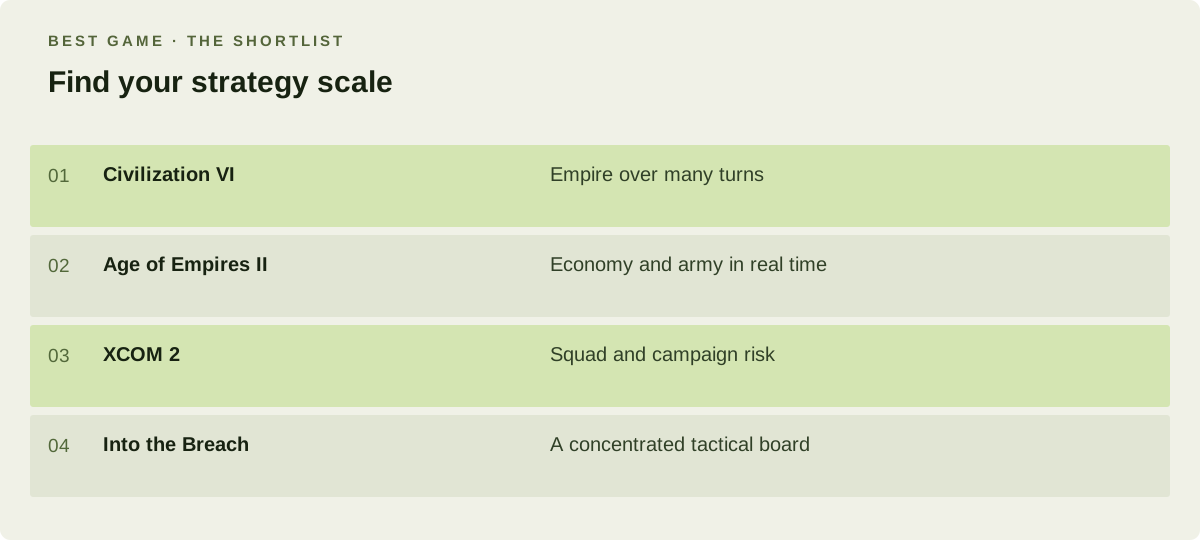
Find your strategy scale. Comparison by play preference, not a numerical score.
Learn the decision loop before the details
Start with one modest goal: keep resource production working, defend a city or understand why a soldier was exposed. Small goals make learning clearer than trying to memorize every unit and upgrade before playing. Tutorials help with controls; a campaign teaches how those controls interact when something goes wrong. Lower difficulty is useful when it gives you room to notice cause and effect.
Real-time strategy emphasizes attention alongside planning, while city-building games may shift the emphasis toward infrastructure rather than defeating a rival. Total War games combine a campaign map with directly commanded battles, creating another balance between these interests. Check the exact edition and expansion rules before following an old tutorial, because content packages can change what a new player encounters at the start.