
Civilization VI is our practical starting recommendation for players who enjoy planning cities on the map. Its districts make geography part of a long-term economic puzzle. Civilization V is a strong alternative if you want cities to feel more concentrated, while Civilization IV preserves a different military logic. Civilization VII deserves consideration on its own terms, but being the newest numbered game does not make it a direct replacement for your preferred rules.

Editorial illustration, not a game screenshot.
Four versions of building an empire
- Civilization VI. Choose VI when you enjoy asking where a campus or industrial district should go before the city needs it. Those placements make terrain matter beyond settling the first tile. The trade-off is a busy strategic picture, especially when expansions introduce additional pressures and long-term decisions.
- Civilization V. V is a useful alternative if VI’s sprawling districts sound more fussy than satisfying. Positioning military units on hexes still matters, but the city itself is less spatially distributed. Check whether you are comparing the base game or a package containing Gods & Kings and Brave New World.
- Civilization IV. IV suits players interested in the series before the later hex-based military redesign. It has a distinct rhythm rather than merely fewer features. Choose it because the older approach interests you; its reputation alone will not remove the adjustment needed for its interface and rules.
- Civilization VII. VII is worth investigating if you want to learn a newer interpretation rather than reproduce a favorite older campaign. Its post-launch changes make current documentation more useful than launch-only impressions. Do not buy it solely on a promise of future updates or assume every announced expansion is already included.
Compare the choices
| Game | Main appeal | Trade-off |
|---|---|---|
| Civilization VI | District placement and map planning | Many systems compete for attention |
| Civilization V | Concentrated cities and hex warfare | Expansion choice changes the experience |
| Civilization IV | Older empire management and stacked armies | More dated interface and presentation |
| Civilization VII | A different campaign structure | Check current rules and included content |
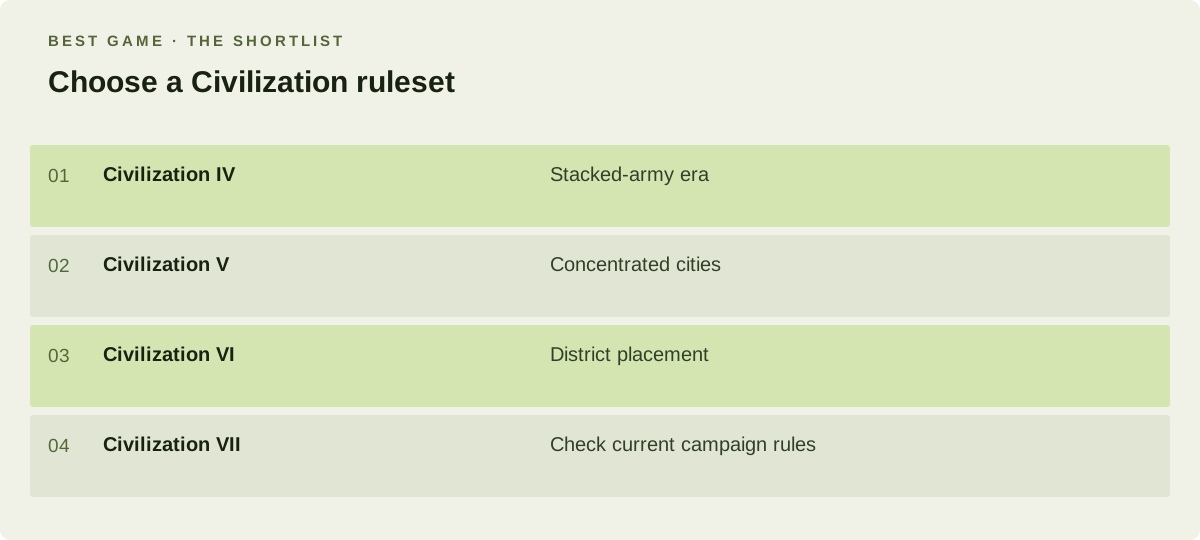
Choose a Civilization ruleset. Comparison by play preference, not a numerical score.
Buy one ruleset before collecting expansions
For a first campaign, reduce the number of competing decisions: choose a manageable map and difficulty, learn how cities grow, and pursue one plausible victory route. Turn-based strategy gives you time to think, but it does not prevent an unfamiliar interface from feeling overwhelming. A smaller first game teaches more than repeatedly restarting a huge one.
Compare packages by their actual contents rather than words such as Complete or Deluxe. Expansions can change the rules, so a base-game tutorial may not explain everything in an expanded campaign. City-building games concentrate on urban management; Civilization asks you to balance cities against rivals and a victory condition. Total War games put more emphasis on commanding battles directly. Those distinctions are more useful than choosing whichever edition has the largest list of leaders.