
Good co-op gives every player a reason to contribute. That might mean sharing clues, specialising in a team role or overcoming a sequence designed for exactly two people. It does not necessarily mean a relaxed evening: friendly games can still expose differences in confidence, patience and experience. This shortlist separates a two-player campaign from repeatable group missions and puzzles. Decide who is playing, where they will sit and how often the group can meet before choosing. Those arrangements matter more than the position of a title in a general multiplayer ranking.
Editorial illustration, not a game screenshot.
Which game should you choose?
- Split Fiction: Choose it for a two-person adventure that repeatedly changes the task rather than asking one confident player to carry a passive companion. Its science-fiction and fantasy settings support varied cooperative challenges. It requires two participants. Check the Friend’s Pass and supported crossplay arrangements for your editions; this is not a campaign you can simply continue alone.
- Portal 2: Choose it when talking through a problem is the attraction. Its dedicated two-player campaign asks you to coordinate portals and timing, making explanation part of the solution. A veteran can accidentally solve everything aloud. Give each partner time to inspect the chamber before announcing an answer, especially if you know the puzzles already.
- Deep Rock Galactic: Choose it for repeatable expeditions where equipment and class roles encourage cooperation. Exploring caves, collecting resources and surviving the return journey creates more than a simple shooting gallery. Check platform and storefront compatibility before buying for a group. The existence of several versions does not mean every pair of versions can connect.
- Overcooked! 2: Choose it for coordinated chaos in which passing ingredients and dividing kitchen jobs matters as much as individual speed. It suits a group willing to laugh and revise its plan. Timers and shared mistakes can frustrate players who want a calm evening. Agree to rotate roles and restart without assigning blame.
| Game | Best fit | Main consideration |
|---|---|---|
| Split Fiction | Exactly two adventurers | Both players participate |
| Portal 2 | Two-player puzzle solving | Balance prior knowledge |
| Deep Rock Galactic | Small-group expeditions | Storefront compatibility |
| Overcooked! 2 | Kitchen coordination | Time pressure |
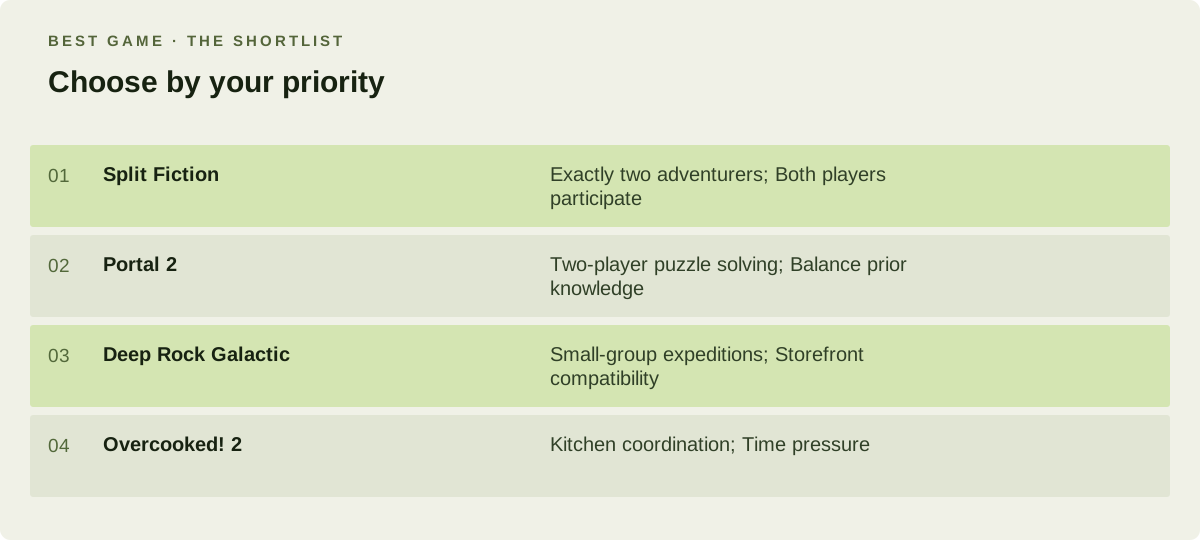
Choose by your priority. Comparison by play preference, not a numerical score.
What matters before you start?
Begin with the group’s weakest practical requirement: one shared screen, different consoles, a slower connection or a player new to controllers. Then verify that the selected version actually supports the required arrangement. Local co-op is not synonymous with online play, and crossplay support is a further question. Some campaigns use one host’s save, while others make progression easier to share. Check that detail before investing several evenings. A short introductory session is also valuable: it reveals whether everyone enjoys the task before the group commits to a long campaign.
Make the choice fit your routine
Choose Split Fiction for a scheduled partnership, Portal 2 for patient discussion, Deep Rock Galactic for returning squad sessions and Overcooked! 2 for a social challenge. Two-player games and four-person games create different expectations, so do not choose solely by the maximum player count. If the group wants to sit together, prioritise couch co-op and clear shared-screen information. If everyone plays remotely, consider voice chat and scheduling as part of the setup. The most useful co-op purchase is the one the whole group can comfortably start, understand and return to.