Zelda is not one design repeated with a new map. Breath of the Wild invites you to improvise across a landscape; Ocarina of Time builds its adventure around carefully staged discoveries; A Link Between Worlds gives top-down puzzles an unusually flexible structure. These choices offer distinct starting points.
Editorial illustration, not a game screenshot.
Zelda adventures for different kinds of exploration
- The Legend of Zelda: Breath of the Wild: Choose it for wandering, observation and solutions assembled from terrain and a small set of flexible tools. Its strength is the freedom to follow an interesting shape on the horizon and discover your own route. Weapons break, and the lightly directed structure expects you to set goals.
- The Legend of Zelda: Tears of the Kingdom: Building machines and combining objects gives the open-world structure a more elaborate problem-solving language. It suits players who enjoyed experimenting in Breath of the Wild and want more possibilities above and below Hyrule. More systems and familiar geography can be overwhelming as a first encounter.
- The Legend of Zelda: Ocarina of Time: A more directed progression makes new equipment and dungeon discoveries feel like clear milestones. Its connected world and focused puzzle spaces remain useful reference points for understanding the traditional 3D Zelda structure. Original N64 controls and presentation differ from later versions.
- The Legend of Zelda: A Link to the Past: A compact top-down world gains complexity through its connected light and dark forms. It is a strong choice when you enjoy learning the relationship between places rather than exploring an enormous landscape. Older signposting can leave you deciding where the next useful discovery lies.
- The Legend of Zelda: A Link Between Worlds: Becoming a painting changes how you read walls, gaps and room boundaries. Renting equipment also loosens the order of exploration, balancing a manageable world with more freedom than a strictly prescribed dungeon sequence. It is a 3DS game, so hardware availability is part of the choice.
- The Legend of Zelda: Link’s Awakening: A smaller island and concentrated dungeon adventure make this an inviting alternative to a vast kingdom. Its strange characters and intimate geography create a recognizable identity even when you already understand the series’ familiar tools. The Game Boy original and Switch remake have different presentation and convenience features.
Compare the games at a glance
| Game | Best fit | Main consideration |
|---|---|---|
| The Legend of Zelda: Breath of the Wild | Open-ended discovery | Equipment durability |
| The Legend of Zelda: Tears of the Kingdom | Construction and experimentation | A denser toolkit |
| The Legend of Zelda: Ocarina of Time | Traditional 3D dungeons | Version and control differences |
| The Legend of Zelda: A Link to the Past | Classic top-down exploration | Older guidance conventions |
| The Legend of Zelda: A Link Between Worlds | Flexible top-down puzzles | Requires compatible 3DS hardware |
| The Legend of Zelda: Link’s Awakening | A compact island adventure | Specify original or remake |
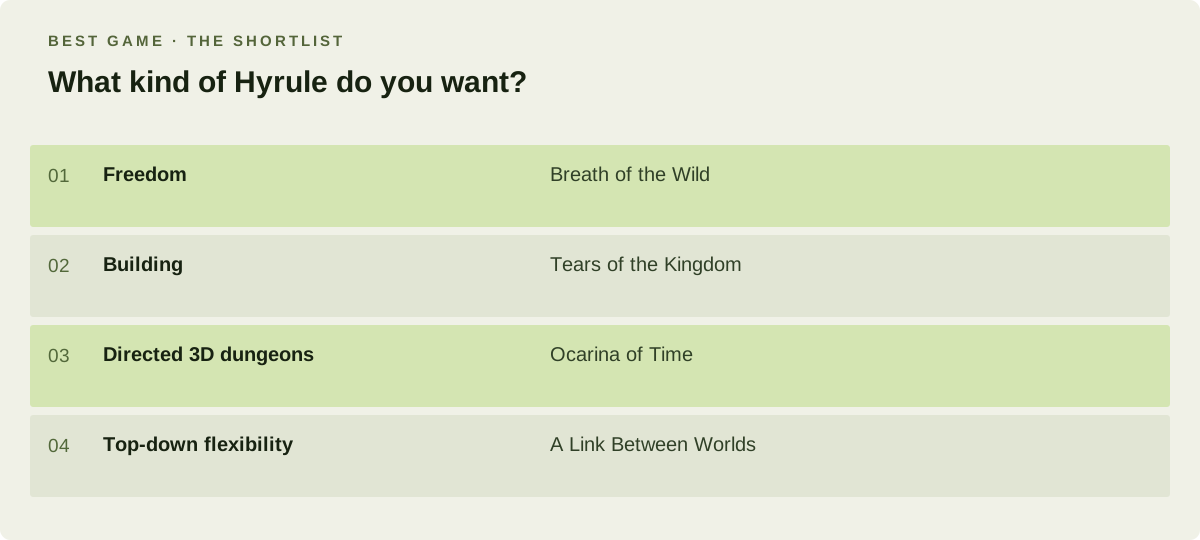
What kind of Hyrule do you want?. Comparison by play preference, not a numerical score.
How to choose without buying twice
Start with Breath of the Wild if open-world games appeal because you can choose a direction without permission. Pick Ocarina when you want a clearer progression of dungeons and equipment. A Link Between Worlds offers a useful middle ground: a compact map with room to choose your route. Tears of the Kingdom is the natural experiment-heavy follow-up, while Link’s Awakening is easier to approach when a smaller setting feels reassuring rather than restrictive.
Choose the version as carefully as the title. The Switch 2 editions of Breath of the Wild and Tears of the Kingdom add hardware-specific improvements; they do not turn those features into original Switch capabilities. Classic reissues and remakes can also change controls or presentation. Switch games provide several convenient Zelda options, while 3DS games and SNES games place the older designs alongside their contemporaries. Release order is optional; a good first Zelda matches your preferred kind of exploration.