
Hades is our recommendation for action players who want repeated attempts to carry an ongoing story. Slay the Spire is the stronger fit if a difficult decision sounds better than a difficult dodge. Roguelike is often used broadly for games organized around changing runs and consequential failure; some of these are more precisely called roguelites. The useful distinction is what survives a defeat: knowledge, unlocks, permanent strength or a mixture of them.

Editorial illustration, not a game screenshot.
Four games that make restarting worthwhile
- Hades. Hades gives each attempt a place in a larger journey rather than treating defeat as a blank reset. Weapons and temporary boons alter the immediate combat puzzle. Choose it when you want reflexes and story together, with an optional God Mode that improves resilience without replacing the whole game.
- Slay the Spire. The key decision is often whether a card improves your current deck, not whether it looks powerful in isolation. Changing routes, relics and encounters prevent a single fixed plan from solving every run. Choose it when you want time to think and can enjoy learning from a losing strategy.
- Into the Breach. Enemy attacks are shown before they resolve, making the challenge about finding a workable response. Moving an enemy can matter more than damaging it. This is a strong choice for deliberate problem solving, though a small board should not be confused with a simple or forgiving decision.
- Spelunky 2. Spelunky rewards careful observation of a world whose traps, enemies and objects can affect one another. A familiar-looking situation can produce a new disaster. Choose it if learning rules through repetition feels satisfying; it is a harsher fit when sudden failure makes you want to stop rather than investigate.
Compare the choices
| Game | Main appeal | Trade-off |
|---|---|---|
| Hades | Action runs and ongoing character stories | Permanent progression changes the restart |
| Slay the Spire | Deckbuilding and risk management | A promising deck can still fail |
| Into the Breach | Compact turn-based tactical problems | Saving every objective may be impossible |
| Spelunky 2 | Platforming and interacting hazards | Mistakes can end a run abruptly |
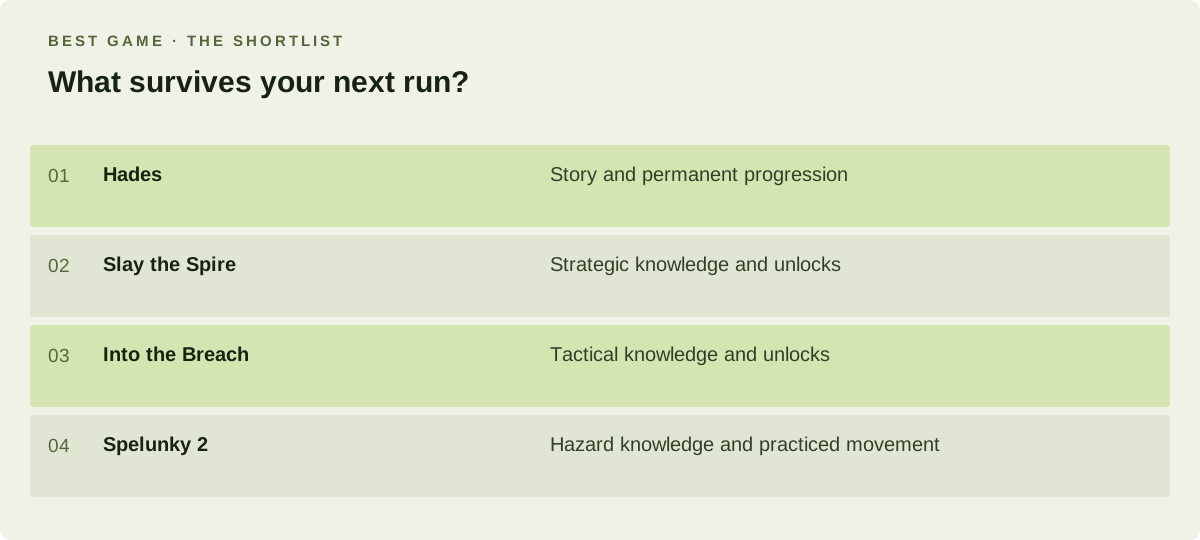
What survives your next run?. Comparison by play preference, not a numerical score.
Choose a restart you can accept
Before buying, ask whether you enjoy repeating early areas and whether progress must be visibly permanent. Failure should teach you something, but different games make that lesson more or less explicit. Hades provides narrative continuity and progression; Slay the Spire makes strategic understanding central; Spelunky asks you to internalize hazards. Those approaches can appeal to very different players.
Indie games contain many run-based experiments, while strategy games provide another route into repeatable decisions without fast action. A run is not necessarily a short session, so check save-and-resume behavior on your chosen platform if interruptions are common. Start by understanding one weapon, character or squad instead of treating every unlocked option as something you must master immediately. A narrower learning goal makes an unsuccessful attempt more informative.