
The best story games do more than place a film between battles. They let your choices, deductions or understanding become part of how the narrative reaches you. That can mean a branching conversation, a mystery assembled from evidence or a relationship developed through repeated visits. This shortlist keeps its descriptions spoiler-free and separates those approaches. A long script is not automatically a better story, and a game with little dialogue can still deliver a strong narrative. Choose the kind of participation you enjoy before worrying about which ending other players consider best.

Editorial illustration, not a game screenshot.
Which game should you choose?
- Baldur’s Gate 3: Choose it when you want to shape a character through conversations, companions and decisions with consequences. Turn-based battles give practical weight to the abilities and relationships you develop. It is a substantial role-playing commitment, not a short interactive drama. Avoid trying to see every possible outcome on a first playthrough; commitment makes individual choices more meaningful.
- Return of the Obra Dinn: Choose it for a mystery in which observation and deduction do the storytelling. Identifying people and connecting events makes your own understanding the main measure of progress. It expects careful attention and a willingness to reconsider assumptions. Its distinctive high-contrast presentation and scenes of death will not suit every reader.
- Outer Wilds: Choose it for discovering a larger story through exploration. Knowledge changes where you travel and what you understand, so curiosity becomes more valuable than collecting a conventional ladder of equipment. Flight, timing and environmental danger can interrupt discovery. Avoid detailed walkthroughs unless genuinely stuck, because information itself is much of the reward.
- Undertale: Choose it for a compact-looking role-playing adventure that makes you consider how you treat its characters. Its battle interactions and humour are central to the story rather than separate distractions. The gentle surface can become emotionally and mechanically demanding. Go in without an ending checklist if you want your first decisions to feel like your own.
| Game | Best fit | Main consideration |
|---|---|---|
| Baldur’s Gate 3 | Choices and companions | Length and systems |
| Return of the Obra Dinn | Evidence-based deduction | Attention and unsettling scenes |
| Outer Wilds | Exploration and understanding | Spoilers are unusually costly |
| Undertale | Character-focused role-playing | Tone changes and combat |
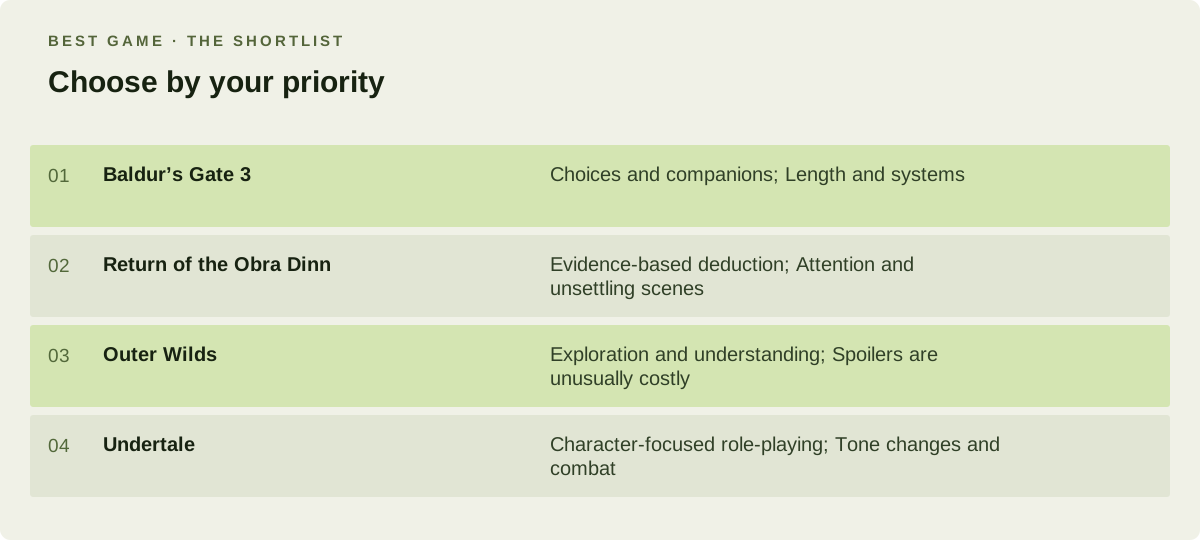
Choose by your priority. Comparison by play preference, not a numerical score.
What matters before you start?
Choose by narrative method. Baldur’s Gate 3 asks what your character would do; Obra Dinn asks what the evidence proves; Outer Wilds asks what you have learned; Undertale asks how you respond to the people in front of you. Those are useful distinctions when a generic story-rich label feels too broad. Check content descriptions and accessibility options without reading plot summaries. You may need readable subtitles, adjustable text or a gentler challenge setting, but the availability of each feature depends on the exact game and edition.
Make the choice fit your routine
For a long relationship with a cast, begin with Baldur’s Gate 3. For a concentrated mystery, choose Obra Dinn; for exploratory revelation, Outer Wilds; for a personal encounter with role-playing conventions, Undertale. Single-player games are a natural neighbouring category, but not every solo game puts narrative first. Likewise, RPG games may offer deep systems with very different storytelling priorities. Keep a few private notes for mysteries rather than immediately searching a solution. A question you answer yourself often remains more memorable than a scene you simply watch, especially in games where understanding is the central action.