Pokémon on Switch is no longer one formula repeated across paired versions. You can explore Hisui while completing research tasks, take part in real-time battles in Lumiose City, follow a familiar Kanto journey, or photograph creatures instead of catching them. The best choice starts with the activity you want to repeat. This guide covers original Switch games; when a release also has a Nintendo Switch 2 edition, check which version you are actually buying.

Editorial illustration, not a game screenshot.
Choose your Pokémon activity
- Pokémon Legends: Arceus: Catching and observation are the center of the experience. Moving through large areas, watching behavior and filling research tasks gives you useful reasons to notice a species you might otherwise ignore after adding it to a collection. It does not offer the conventional competitive trainer-battle structure of the paired mainline games.
- Pokémon Legends: Z-A: Lumiose City provides a more concentrated setting, while real-time battles ask you to consider positioning and timing alongside familiar type relationships. Choose it when you want Pokémon combat to feel different from selecting turns in a menu. The original Switch release and Switch 2 edition are distinct product choices.
- Pokémon Scarlet and Violet: An open region and several progression threads make these attractive when you want more freedom over where a trainer journey goes. The Union Circle gives friends a way to share exploration beyond simply arranging a trade or battle. Performance and visual roughness are important considerations on original Switch hardware.
- Pokémon: Let’s Go, Pikachu! and Let’s Go, Eevee!: A simplified Kanto journey and visible wild Pokémon make these inviting for newcomers or a parent accompanying a child. Catching changes the familiar interaction, while a second player can lend support during the adventure. The catching system differs from standard wild battles; handheld and TV controls also differ.
- New Pokémon Snap: Repeated photography routes become observation puzzles as you learn where creatures appear and how they interact. It suits players drawn to the world and behavior of Pokémon more than team-building or competitive battles. It is a photography spin-off, not an RPG with gyms or a traditional battle party.
Compare the games at a glance
| Game | Best fit | Main consideration |
|---|---|---|
| Pokémon Legends: Arceus | Field research and active catching | Different multiplayer expectations |
| Pokémon Legends: Z-A | City exploration and real-time battles | Check the hardware edition |
| Pokémon Scarlet and Violet | Open-region trainer adventure | Technical roughness |
| Pokémon: Let’s Go, Pikachu! and Let’s Go, Eevee! | A gentle Kanto introduction | Simplified catching and support co-op |
| New Pokémon Snap | Observation and photography | Routes are revisited repeatedly |
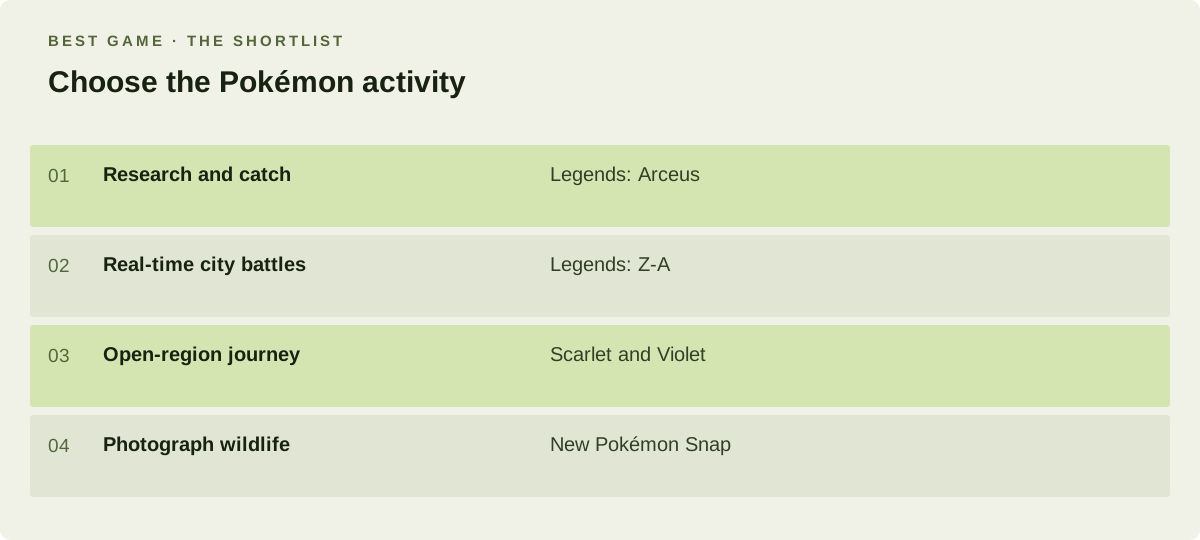
Choose the Pokémon activity. Comparison by play preference, not a numerical score.
How to choose without buying twice
Arceus is the strongest fit when the act of finding and catching is the attraction. Choose Z-A specifically for its city setting and combat change, rather than expecting another map structured like Hisui. Scarlet and Violet are closer to an expansive trainer journey; Let’s Go is gentler and easier to share with a beginner. Snap is valuable precisely because it gives creatures a different purpose. None needs to replace every other Pokémon game, and the best first purchase follows your preferred activity rather than release order.
Check local and online features separately before planning a shared playthrough. A support partner, a shared exploration session and competitive battles are different forms of multiplayer. Paired versions share the core game, so most players should choose one instead of buying both automatically. DS Pokémon games and 3DS Pokémon games remain relevant for traditional campaigns, but require older hardware. For a broader view of newer hardware, Switch 2 games include enhanced editions whose features should not be assumed available on the original console.