There is no single Pokémon game that delivers every version of the series at its best. A player who wants badges and a settled team may prefer HeartGold and SoulSilver; someone tired of that structure may enjoy the field research of Legends: Arceus. This shortlist brings together distinct strengths rather than ranking every release. It also separates a recommendation about game design from the practical question of which hardware and cartridge you can reasonably obtain.
Editorial illustration, not a game screenshot.
Pokémon adventures for different priorities
- Pokémon HeartGold and SoulSilver: Johto provides a welcoming badge journey, while the visit to Kanto gives an established team somewhere meaningful to go afterward. Having a Pokémon follow the player adds personality to travel without replacing the traditional battle structure. Original DS cartridges can be difficult to assess; check authenticity and save behavior.
- Pokémon Black 2 and White 2: These sequels revisit Unova with new routes, a broader early team selection and additional activities. They work especially well for players who like a structured campaign but want more to experiment with after learning the basics. Playing Black or White first gives the returning setting and characters more context.
- Pokémon Platinum: Sinnoh rewards patient exploration and offers a recognizable balance of gyms, team building and late-game challenges. Its revised regional options make building a varied party more comfortable than in the original Diamond and Pearl. Battle pacing and older conveniences can feel slow beside newer releases.
- Pokémon Emerald: Hoenn mixes land routes, sea travel and a memorable set of environmental themes. The Battle Frontier gives committed players a reason to think beyond finishing the story and simply overpowering the next trainer. It is a Game Boy Advance game; normal DS models and DSi models differ in cartridge support.
- Pokémon Legends: Arceus: Observing and catching creatures in the field moves attention away from the usual badge ladder. Research objectives make familiar species interesting in a new way, especially when you enjoy learning behavior and planning an approach. Choose it for a largely solo catching adventure, not conventional competitive multiplayer.
Compare the games at a glance
| Game | Best fit | Main consideration |
|---|---|---|
| Pokémon HeartGold and SoulSilver | A traditional journey with breadth | Original DS acquisition |
| Pokémon Black 2 and White 2 | Expanded classic progression | Direct-sequel context |
| Pokémon Platinum | Sinnoh with revised options | Older pacing |
| Pokémon Emerald | Hoenn and battle challenges | Check GBA-compatible hardware |
| Pokémon Legends: Arceus | Field research and catching | Different from the gym formula |
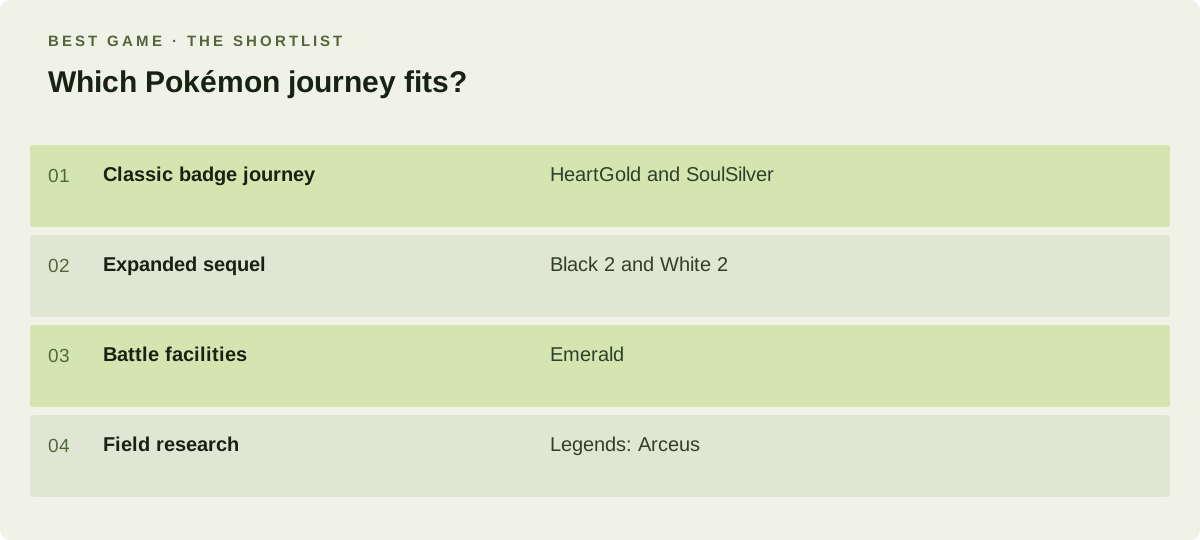
Which Pokémon journey fits?. Comparison by play preference, not a numerical score.
How to choose without buying twice
For a first traditional adventure, start with the system you already own rather than buying old hardware solely for a reputation. HeartGold is a strong classic choice, but accessibility can make Pokémon on Switch more practical. Black 2 and White 2 are better treated as richer follow-ups than as mandatory entry points. Choose Emerald for its battle-focused longevity and Arceus when movement, discovery and catching matter more than maintaining the familiar route from gym to gym.
Paired Pokémon versions share a core adventure but differ in available creatures and other details; you rarely need both to enjoy a campaign. Complete collection goals may require trading and cannot be assumed possible with one cartridge alone. The best DS Pokémon games and 3DS Pokémon games form separate buying decisions because hardware, regions and retired services matter. Avoid choosing on a promised online event, transfer route or used-cartridge bonus that the seller cannot demonstrate.