The Game Boy Advance works especially well when a game makes a small screen feel purposeful. Metroid: Zero Mission turns a compact map into an evolving puzzle, Advance Wars makes every unit readable, and Golden Sun gives a traditional party adventure a strong mechanical identity. These five recommendations cover different kinds of commitment rather than treating a portable game as necessarily short. Choose the activity you want to repeat, then check the most practical way to play that version.
Editorial illustration, not a game screenshot.
GBA games with different strengths
- Metroid: Zero Mission: A clear progression of movement tools makes earlier passages worth revisiting. Its compact structure and responsive action provide an approachable route into Metroid’s exploration, while optional discoveries give experienced players reasons to scrutinize the map more closely. This is a reimagining of the original Metroid, not the same game with a different screen.
- Advance Wars: Clear unit roles and property income turn the battlefield into a readable planning problem. Capturing ground matters because it changes what you can afford next, making position and economy more valuable than simply attacking whatever is nearest. Later missions expect careful play despite the inviting colors and introductory lessons.
- Pokémon Emerald: Hoenn’s mix of land and sea makes a long team-building journey distinctive. The Battle Frontier gives dedicated players additional reasons to refine their approach after the main story, rather than treating the credits as the only meaningful goal. Check cartridge authenticity and save behavior; an old internal battery can affect time-based events.
- Golden Sun: Elemental abilities connect combat, puzzles and character development, so the party’s powers matter outside battles too. Djinn give experimentation a tangible purpose, making this appealing when you want a traditional RPG with more systems to investigate. Its story continues in The Lost Age rather than resolving every thread here.
- The Legend of Zelda: The Minish Cap: Shrinking changes how familiar spaces are read, turning ordinary objects into routes and obstacles. The concentrated world suits players who prefer discovering relationships between places to crossing a huge map full of distant objectives. Choose it for a solo dungeon adventure, not the multiplayer structure of Four Swords.
Compare the games at a glance
| Game | Best fit | Main consideration |
|---|---|---|
| Metroid: Zero Mission | Compact action and exploration | Revisiting routes is essential |
| Advance Wars | Turn-based strategy | Difficulty grows substantially |
| Pokémon Emerald | Creature collecting and battle facilities | Old-cartridge condition matters |
| Golden Sun | Party building and environmental puzzles | Part of a continuing story |
| The Legend of Zelda: The Minish Cap | Compact top-down puzzles | A solo Zelda adventure |
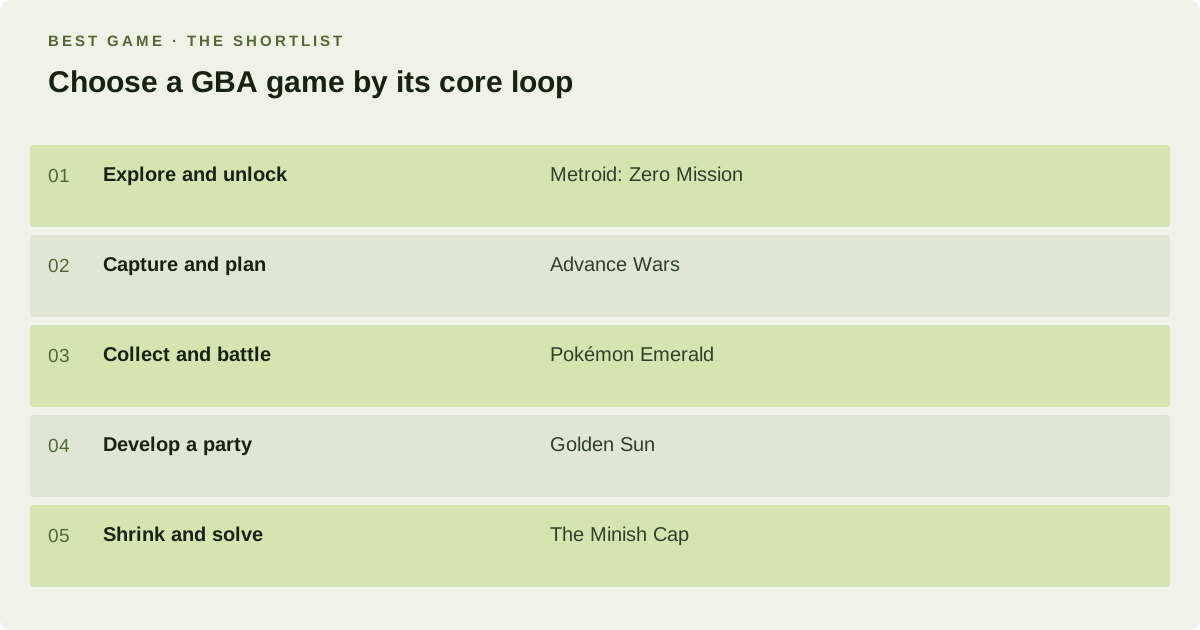
Choose a GBA game by its core loop. Comparison by play preference, not a numerical score.
How to choose without buying twice
Zero Mission is the strongest starting point for players who enjoy moving through a map and gradually understanding its hidden connections. Advance Wars replaces reflexes with deliberate planning. Golden Sun and Emerald make more sense when you want a team to develop over a longer journey, but their goals differ: story and puzzles in one, collecting and battles in the other. The Minish Cap is a particularly good fit for a reader who wants Zelda games with a manageable world and a distinctive central idea.
Original GBA hardware, compatible older DS models and official reissues offer different practical experiences. A DSi or 3DS does not accept GBA cartridges, even though earlier DS models do. Nintendo Classics includes a selection of GBA titles through the relevant subscription tier; check the current regional catalogue rather than assuming this entire list is included. DS games continue the portable lineage, while SNES games show several of the 2D design traditions that GBA developers adapted for a smaller screen.