Multiplayer is not one genre. A tense tactical round, a physics-based sporting match and a cooperative expedition ask for different skills and different attitudes towards losing. The best multiplayer games give your group a clear activity it wants to repeat, rather than merely offering a large player count. This shortlist covers both competition and cooperation. It does not promise queue times, current player totals or a frictionless experience for every region. Free games still require time and attention. Choose around the people you expect to play with and the amount of learning you actually enjoy.
Editorial illustration, not a game screenshot.
Which game should you choose?
- Rocket League: Choose it for competition with an immediately understandable objective and a long path to mechanical mastery. Driving, positioning and reading a bouncing ball offer different ways to improve alongside a regular partner. A simple premise does not make advanced play easy. Start outside ranked competition while you learn recovery, rotation and how not to chase every ball.
- Counter-Strike 2: Choose it for tactical rounds where positioning, economy and communication shape the outcome. A regular team can develop useful habits around the same limited set of objectives. Its competitive environment can be demanding for beginners. Learn maps and basic utility before expecting consistent results in serious matchmaking.
- Fortnite: Choose it for a changing social space with several kinds of activity. Zero Build offers a different starting point from construction-heavy battle royale, so your group need not begin with the same skill emphasis. Modes, events and presentation change. Pick a specific supported activity and check party settings instead of assuming every Fortnite experience has identical rules.
- Deep Rock Galactic: Choose it when you want human teammates without making other players the enemy. Different equipment and cave objectives encourage shared problem-solving as well as combat. It is cooperative rather than a substitute for a competitive ladder. Agree on mission difficulty and time commitment so one player does not set the pace for everyone.
| Game | Best fit | Main consideration |
|---|---|---|
| Rocket League | Sporting team matches | Mechanical learning curve |
| Counter-Strike 2 | Tactical PC competition | Knowledge and teamwork |
| Fortnite | Varied social competition | Mode-specific rules |
| Deep Rock Galactic | Cooperative squad missions | Shared mission expectations |
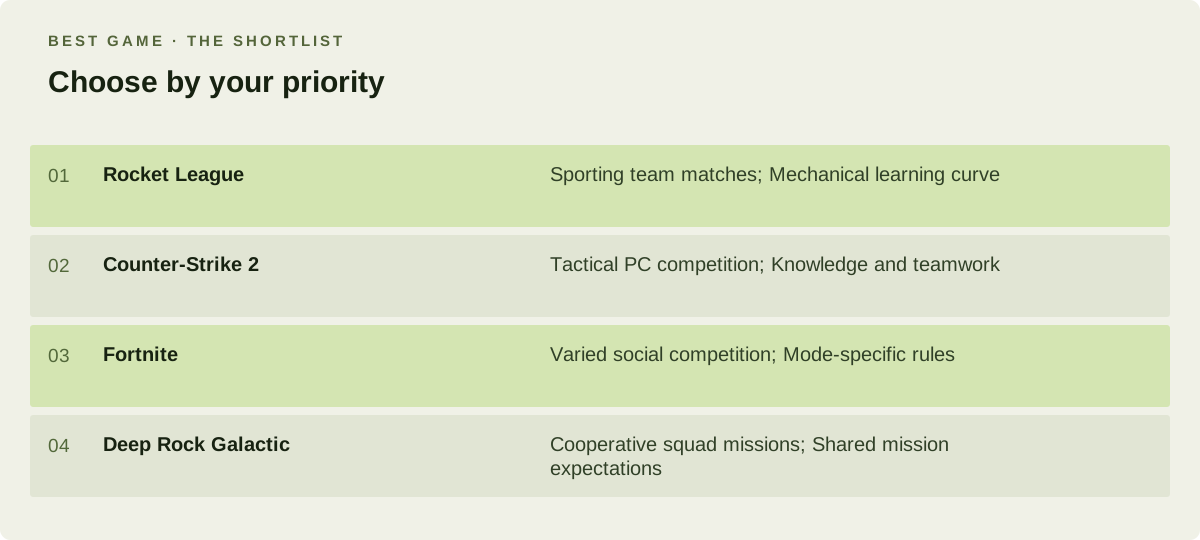
Choose by your priority. Comparison by play preference, not a numerical score.
What matters before you start?
Decide whether the group wants to win against other players, complete a task together or simply spend time in a shared space. That choice filters the field more effectively than asking which game is most popular. Check hardware, supported platforms and account requirements before inviting friends. Crossplay and cross-progression are separate features: being able to join a match does not guarantee that purchases or saves follow you everywhere. For younger players, review communication controls and spending settings before the first session, using the current platform guidance.
Make the choice fit your routine
Rocket League is a strong fit for a regular duo who enjoy visible improvement; Counter-Strike 2 rewards a more deliberate commitment to tactical learning. Fortnite suits groups who want variety, while Deep Rock Galactic supports a shared objective without competitive opponents. Co-op games can be the better choice when skill differences make direct competition uncomfortable. Two-player games may also be easier to schedule than a full squad. Whatever you pick, begin with a modest session and agree what makes an evening successful. Winning every match is a poor requirement for enjoying a game built around repeated competition.