A free game removes the purchase price, not every cost of playing. Time, storage, accounts and optional spending still matter, particularly when a game is designed to become a long-term habit. The best free games offer a worthwhile activity before you buy extras. This shortlist covers different reasons to play rather than assuming the largest live service suits everybody. These are free-to-play recommendations, not temporary giveaways, subscription benefits or demos labelled as complete games. Check the current store listing in your region before downloading and decide your spending limits before browsing the shop.
Editorial illustration, not a game screenshot.
Which game should you choose?
- Rocket League: Choose it for a clear sporting challenge with a long route to mastery. Driving and striking a ball provides an immediately understandable objective while positioning and recovery keep a regular partnership interesting. Its cosmetic economy is separate from learning the game. Start with casual matches and basic control practice instead of assuming new items will improve your results.
- Warframe: Choose it for cooperative action and long-term equipment projects. Movement, missions and different combat approaches provide room to experiment once you begin understanding the surrounding systems. Its accumulated progression systems can overwhelm new players. Learn one goal at a time and understand currencies, crafting and storage before deciding whether to spend.
- Brawlhalla: Choose it for platform fighting you can try without purchasing a roster-sized investment first. Casual rooms let a group establish its own rhythm before taking competition more seriously. Character access and cosmetic purchases need checking against the current model. Skill differences matter much more than the cheerful presentation suggests, so begin with approachable rules.
- Dota 2: Choose it when learning a deep team strategy game is itself the attraction. Heroes, map control and coordination create a large space for developing expertise with a regular group. Matches require attention and the knowledge barrier is high. Tutorials and practice are a better starting point than treating your first competitive games as disposable experiments.
| Game | Best fit | Main consideration |
|---|---|---|
| Rocket League | Physics-based competition | Mechanical practice |
| Warframe | Cooperative progression | Complex systems and optional spending |
| Brawlhalla | Casual platform fighting | Roster and skill differences |
| Dota 2 | Long-term team strategy | Steep learning curve |
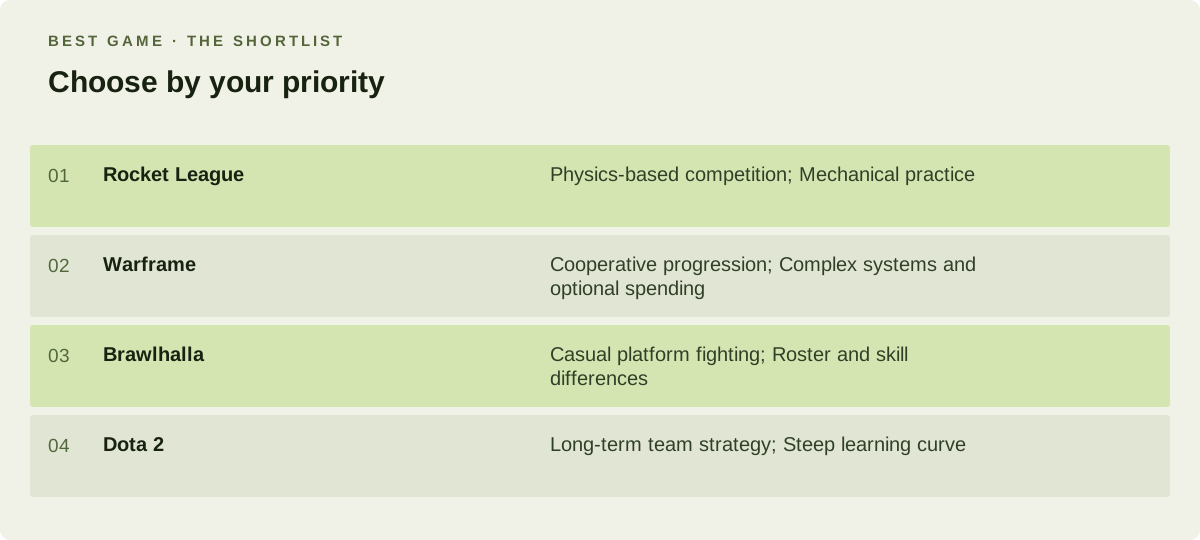
Choose by your priority. Comparison by play preference, not a numerical score.
What matters before you start?
Decide whether you want a few enjoyable matches or a game to return to for months. The latter can justify learning complex systems, but it can also create pressure to keep up with events. Review optional purchases, spending controls and any account requirements before the first session. Free-to-play does not necessarily mean every expansion, character or mode is included. Likewise, a game available on several systems may have restrictions on crossplay or account progression. Read the current official guidance if moving between devices matters to you.
Make the choice fit your routine
Rocket League and Brawlhalla offer clear match-based activities; Warframe suits a cooperative progression project, while Dota 2 demands a longer strategic education. Before choosing among free PC games, check the publisher’s launcher, hardware requirements and account rules. Free Steam games can still require an additional account; free PS5 games may have different progression or add-on entitlements. If you prefer a complete download without a live-service shop, consider open-source games. Learn one game’s basics, then judge whether the underlying activity stays enjoyable without buying anything. A free installation still takes up your evening.