The best fighting game is one you want to return to after losing a close round. Visual style, characters and the people you can play with matter alongside the depth of its systems. This selection distinguishes grounded two-dimensional competition, three-dimensional movement, expressive anime combat and platform fighting. Each offers a different route to satisfying matches. Buying the most fashionable game is less useful than choosing a ruleset and roster that make practice feel worthwhile.
Editorial illustration, not a game screenshot.
Which games should you choose?
- Street Fighter 6: Choose it for learning spacing, defence and deliberate exchanges. Its alternative control options reduce the initial input barrier, while World Tour gives newcomers another way to become familiar with characters and techniques. Simplified inputs do not remove tactical decisions, and online features require attention to account and platform requirements.
- Tekken 8: Choose it for close-range exchanges and three-dimensional movement. Learning when to sidestep, punish an unsafe attack or recognize a familiar sequence gives individual matchups a distinctive character. Large move lists can be intimidating; a small useful toolkit is a better first goal than memorizing everything.
- Guilty Gear Strive: Choose it for strongly differentiated characters and stylish, expressive battles. The roster’s unusual tools make discovering a favourite fighter part of the pleasure, with movement and pressure central to the appeal. Character differences can make early matches confusing; use tutorials and learn one matchup rather than treating every opponent identically.
- Super Smash Bros. Ultimate: Choose it for flexible local gatherings and a platform-fighting ruleset. Stage position and recovery matter as much as landing attacks, and match settings can support very different levels of seriousness. Its competitive conventions differ from traditional fighters; agree on items, stages and rules before a mixed-skill group starts.
Compare the main differences
| Game | Best fit | Main consideration |
|---|---|---|
| Street Fighter 6 | Accessible routes into fundamentals | Account requirements and optional content |
| Tekken 8 | Three-dimensional combat and matchups | Extensive move knowledge |
| Guilty Gear Strive | Distinctive anime-style characters | Matchup learning takes time |
| Super Smash Bros. Ultimate | Local groups and platform combat | Rules strongly change the experience |
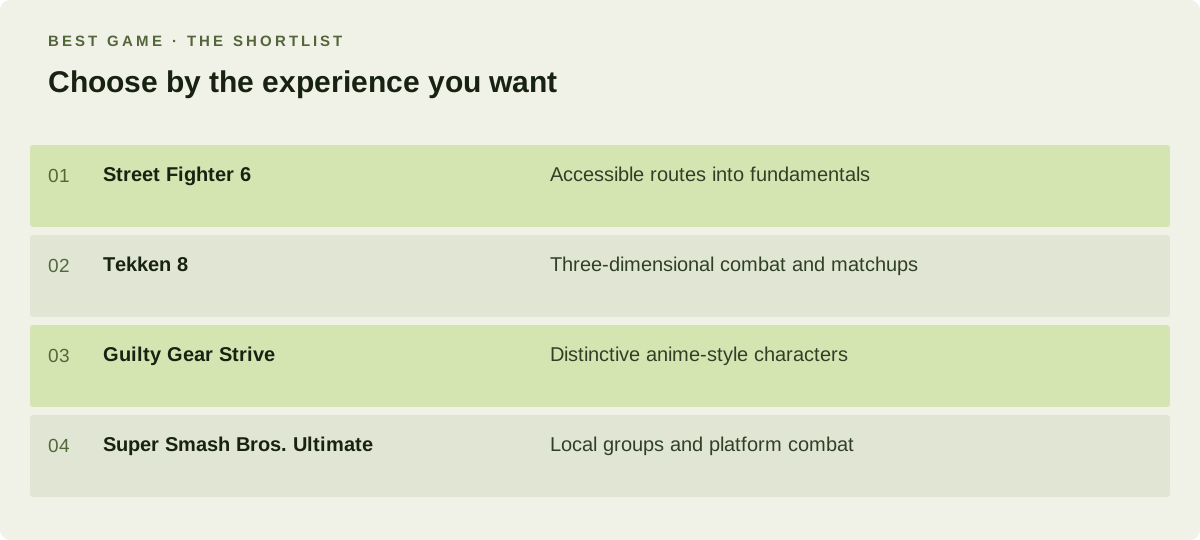
Choose by the experience you want. Comparison by play preference, not a numerical score.
Buy for the matches you will actually play
Street Fighter 6 is the most straightforward recommendation when you want a structured introduction to traditional fighting-game decisions. Tekken 8 rewards movement and familiarity, while Strive makes character identity especially prominent. Smash Ultimate is the natural choice when the same game must entertain a group on one screen. These preferences are more useful than an invented ranking of which game is hardest.
Check whether a favourite character belongs to the base roster or paid content, and confirm platform compatibility with friends. Online support and local player counts vary between titles and modes. A stable connection also matters for competitive multiplayer. During practice, focus on one defensive habit and one reliable response before learning long combos. Being able to recognize why an exchange went wrong makes improvement easier to sustain, even when the result is still a loss.