A multiplayer recommendation fails if the group cannot use it. Splatoon 3 is a strong team game, but it cannot put four friends on one television. Super Smash Bros. Ultimate can host a much larger local fight, while Mario Party asks everyone to settle in for a longer session. These choices cover different social situations on the original Switch, with the setup limitations visible before you buy controllers, extra copies or a subscription.
Editorial illustration, not a game screenshot.
Multiplayer picks and their setups
- Mario Kart 8 Deluxe: Short races and optional driving assists make it easy to mix newcomers with regular players. Four-player split screen is an especially practical starting point for a living room, and battle modes change the pace without requiring another game. Online races require a suitable subscription; additional tracks are a separate content decision.
- Super Smash Bros. Ultimate: Flexible rules let a group choose chaotic item-heavy battles or more deliberate contests. Its broad character roster makes it a lively social game, while training and predictable rules can support players who want to improve over time. Up to eight local fighters can make small screens difficult to read.
- Splatoon 3: Painting territory gives teams useful jobs beyond simply winning every duel. Competitive modes offer room to develop movement and map awareness, while Salmon Run provides a cooperative alternative when the group wants to face waves together. There is no split screen; each multiplayer participant needs a console and game copy.
- Super Mario Party Jamboree: Board movement, changing fortunes and short minigames make the social conversation part of the entertainment. It fits groups who enjoy an unfolding session more than a sequence of isolated matches decided entirely by mechanical skill. A full board session takes time, and controller requirements vary by mode.
- Nintendo Switch Sports: Physical gestures make bowling, tennis and other sports immediately understandable to many occasional players. It is useful when everyone would rather stand up and participate than learn a large set of button combinations. Supported Joy-Con controls are required; handheld mode and Pro Controllers are unsuitable.
Compare the games at a glance
| Game | Best fit | Main consideration |
|---|---|---|
| Mario Kart 8 Deluxe | Up to four on one screen | Extra courses are additional content |
| Super Smash Bros. Ultimate | Large local fighting groups | Crowded fights need a readable screen |
| Splatoon 3 | Friends with separate consoles | No same-screen multiplayer |
| Super Mario Party Jamboree | A planned party session | Check time and controller needs |
| Nintendo Switch Sports | Motion-based social play | Needs suitable space and controllers |
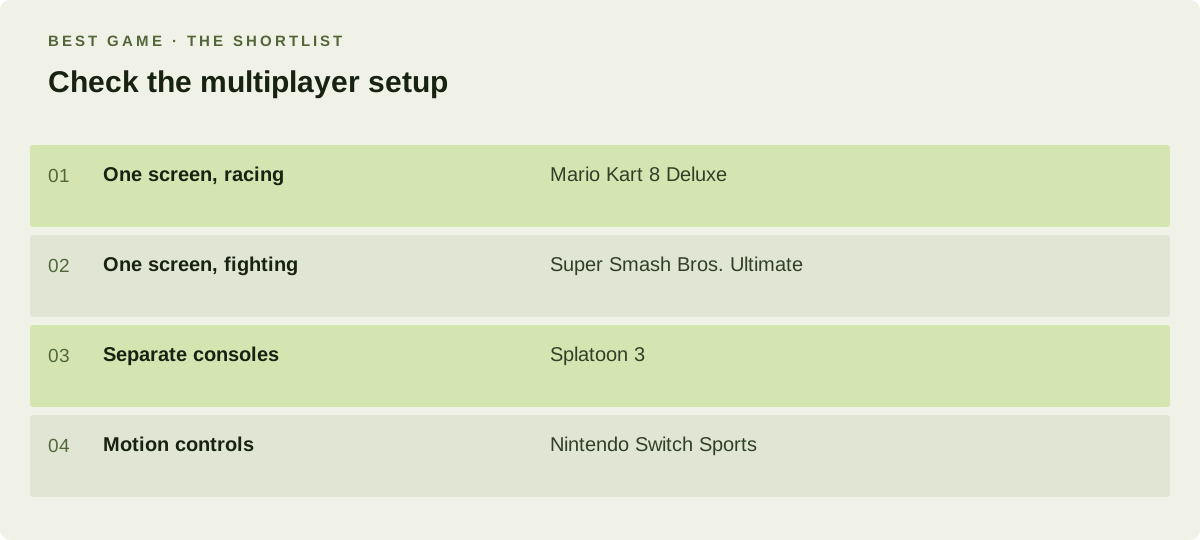
Check the multiplayer setup. Comparison by play preference, not a numerical score.
How to choose without buying twice
For an unplanned gathering around one console, Mario Kart is the most straightforward place to start. Smash works when the group enjoys direct competition and agrees on rules before the first match. Jamboree is more suitable when there is time for a board to develop. Switch Sports needs clear room and secure controller straps. Splatoon is the right choice only after confirming everyone has a suitable system; the quality of the team game does not remove that equipment requirement.
Separate the number of local players from local-wireless and online limits on each product page. Those labels describe different arrangements, and a wireless connection does not imply shared-screen support. Switch co-op games are a better fit when winning together matters more than beating friends. Local co-op also covers campaigns with unequal support roles, so check what each person actually controls. Owners of newer hardware should keep Jamboree’s original release separate from its Switch 2 edition and added modes.