Indie is a broad description of production, not a promise that every game is short, gentle or experimental in the same way. On Switch, it can mean the precise jumping of Celeste, the careful planning of Into the Breach or months spent improving a farm. These five selections offer different reasons to play in handheld mode. They are established starting points, chosen for distinctive design rather than a claim to exhaust every worthwhile independent release.
Editorial illustration, not a game screenshot.
Indie games with different core loops
- Hades: Repeated escape attempts combine fast combat, changing upgrades and continuing character conversations. A failed run can still reveal something useful or move a relationship forward, which helps the repetition feel purposeful instead of simply erasing an evening’s progress. Its action loop is demanding; God Mode offers assistance without removing the need to engage.
- Hollow Knight: Exploring an interconnected underground kingdom rewards memory, observation and the willingness to revisit a suspicious passage. New movement tools change how earlier places work, while restrained storytelling leaves room for curiosity. Navigation, boss fights and recovering after defeat can be more demanding than the art suggests.
- Stardew Valley: Farming, fishing, mining and village relationships give you several ways to define a productive day. It is especially appealing when you want a lasting personal project whose priorities can change as you understand the town. The daily clock and limited energy mean relaxed presentation does not remove resource decisions.
- Celeste: Small rooms and quick restarts turn difficult platforming into a clear sequence of experiments. Its movement asks for precision, while Assist Mode options let players adjust particular barriers rather than abandon the whole climb. Even with frequent checkpoints, repeated attempts are central to the experience.
- Into the Breach: Visible enemy intentions transform each turn into a compact positional puzzle. Protecting buildings and redirecting attacks often matter more than dealing maximum damage, so the tiny battlefield can support surprisingly difficult choices. Choose it for concentrated tactics, not an expansive story campaign or free-form exploration.
Compare the games at a glance
| Game | Best fit | Main consideration |
|---|---|---|
| Hades | Repeatable action with story | Runs revisit familiar spaces |
| Hollow Knight | Exploration and combat mastery | Can be punishing and opaque |
| Stardew Valley | An ongoing personal project | Time and energy management |
| Celeste | Focused movement challenges | A deliberate retry loop |
| Into the Breach | Readable turn-based puzzles | Small maps and repeated runs |
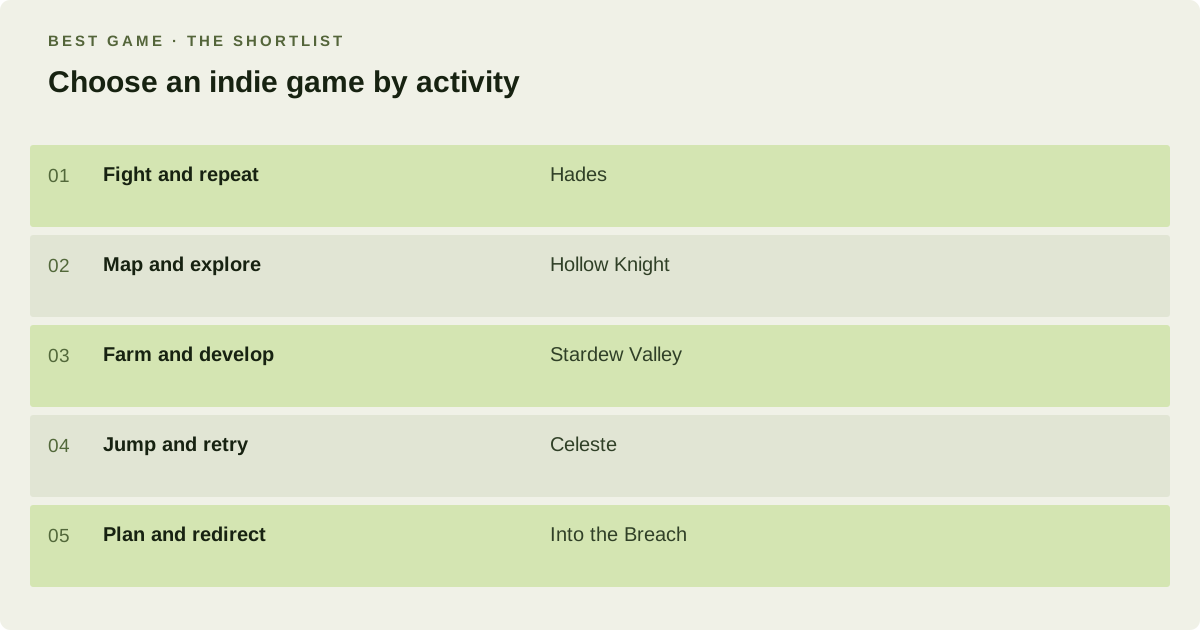
Choose an indie game by activity. Comparison by play preference, not a numerical score.
How to choose without buying twice
For short bursts, Celeste provides natural stopping points and Into the Breach lets you consider a turn without a reflex deadline. Hades is better when you want an energetic run and a reason to attempt another. Hollow Knight benefits from enough continuity to remember its geography. Stardew Valley is the slow-burn choice, although setting one modest daily goal helps prevent its many systems becoming a checklist. These differences are more useful than treating indie games as a single genre.
Read the original Switch product page for controls and multiplayer details instead of assuming the same features as a PC release. Stardew Valley’s original Switch split screen, for example, is limited to two players; its newer Switch 2 edition differs. Switch co-op games provide a more specific starting point for a shared purchase. Fans of Hollow Knight may prefer metroidvania games, while Hades points toward roguelike games and their repeated-run structures. A farm-centered preference can lead toward cozy games instead.