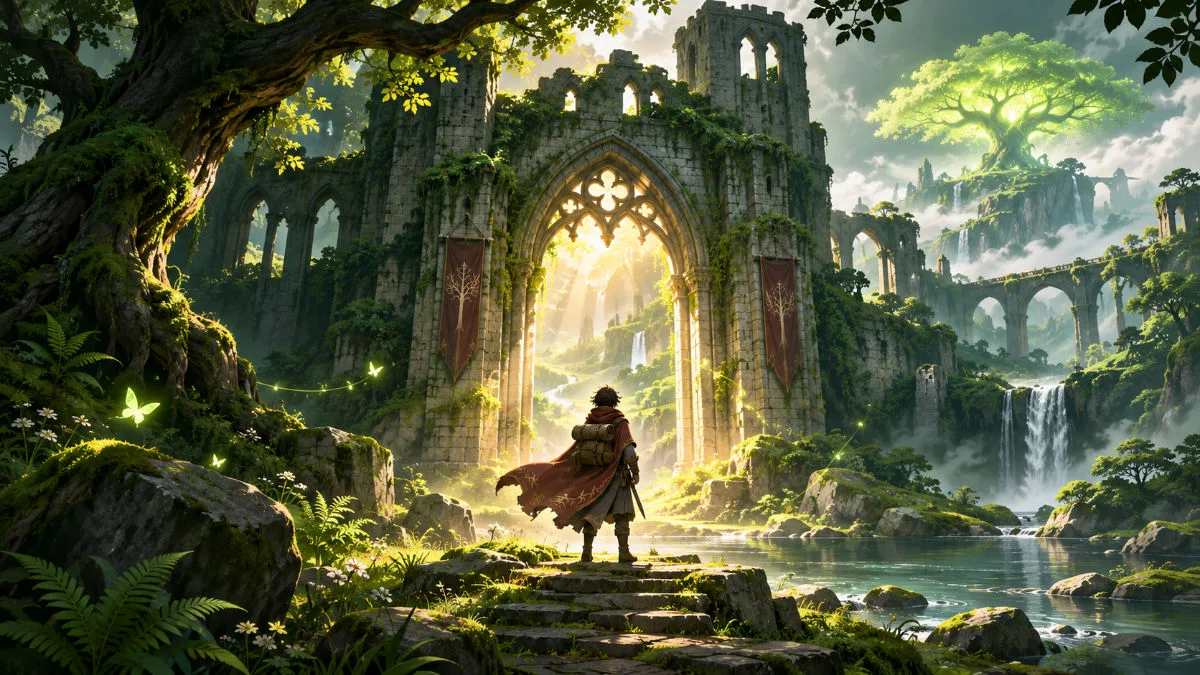
The best Final Fantasy starting point is rarely determined by the number on its cover. Most numbered entries introduce their own world, cast and systems, so a preference for turn-based decisions or immediate action is more useful than release order. These five picks offer distinct experiences. They are starting points for different players, not a claim that one era or combat style defines the entire series.
Editorial illustration, not a game screenshot.
Which games should you start with?
- Final Fantasy VI — An ensemble cast and an ambitious fantasy world make this a strong route into the pixel-era games. Choose it if character stories and party building matter more than cinematic presentation, with willingness to learn older battle and exploration conventions. Its presentation remains rooted in classic 2D RPGs.
- Final Fantasy IX — A warm surface and reflective character stories support a deliberately traditional fantasy journey. It is the pick for someone attracted to distinctive party roles, towns and exploration rather than a complex action system or a modern open-world structure. Battles and transitions can feel slow.
- Final Fantasy X — A clearly directed pilgrimage and readable turn-based battles make this an approachable first choice. Changing party members to answer different enemy types gives strategy an immediate purpose without asking you to navigate a complicated world map. The route is guided for much of the story.
- Final Fantasy XII: The Zodiac Age — Exploration and configurable gambits let you build rules for how the party behaves. Choose it when designing an effective team system sounds satisfying, especially if you want to adjust tactics rather than issue every routine command manually. Some players dislike automating regular actions.
- Final Fantasy XVI — Direct action combat makes this the clearest alternative for players who want to control one fighter’s timing and abilities. Its dramatic fantasy story emphasizes spectacle and a central protagonist rather than traditional command-based party management. Its mature tone and structure differ from older entries.
Compare the shortlist
| Game | Best fit | Main compromise |
|---|---|---|
| Final Fantasy VI | An ensemble pixel-era adventure | Its presentation remains rooted in classic 2D RPGs. |
| Final Fantasy IX | A traditional character-led journey | Battles and transitions can feel slow. |
| Final Fantasy X | An approachable turn-based introduction | The route is guided for much of the story. |
| Final Fantasy XII: The Zodiac Age | Party systems and tactical preparation | Some players dislike automating regular actions. |
| Final Fantasy XVI | An action-led dramatic adventure | Its mature tone and structure differ from older entries. |
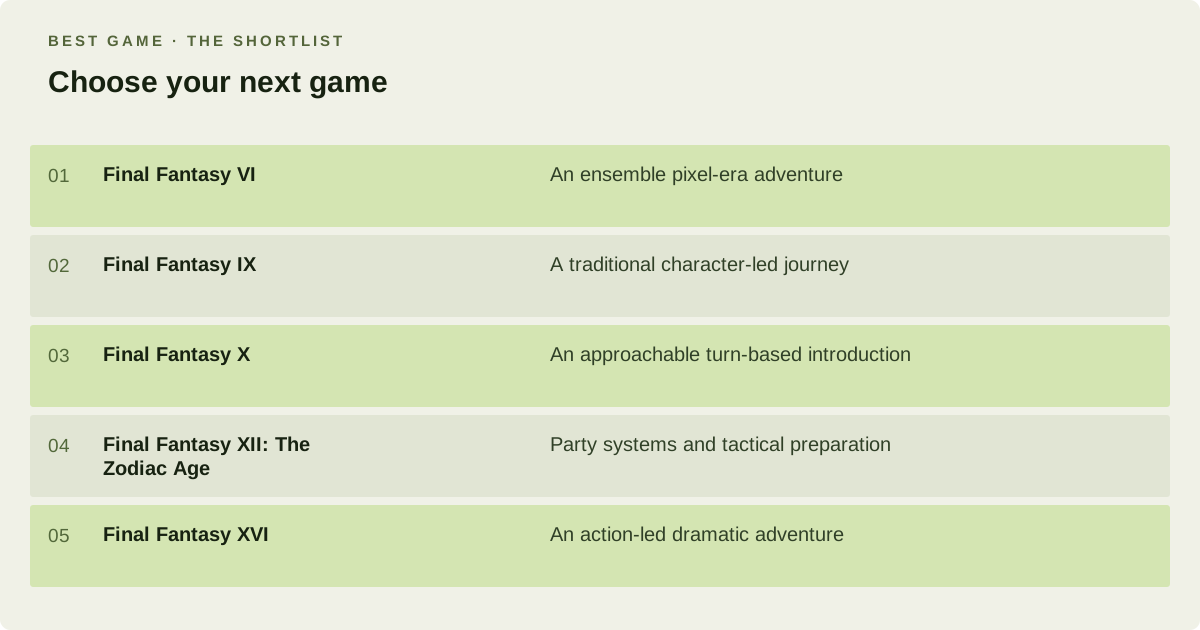
Choose your next game. Comparison by play preference, not a numerical score.
Pick the system you want to learn
Begin with a combat preference. Final Fantasy X is the clearest recommendation here for learning readable turn-based decisions. XII favors configuring a party, XVI favors immediate action, and VI or IX suit someone deliberately seeking the feel of an older RPG. You can change eras later without treating the numbering as homework.
Exact edition names matter. The Zodiac Age is a particular version of XII with its own refinements. Pixel Remaster editions modernize the presentation and convenience of the early games. The original Final Fantasy VII and the Remake project also have different structures; a familiar character on the cover does not make them interchangeable releases.
PS1 games and PS2 games help place IX, X and the original XII in their console context. JRPG games offer broader alternatives for party-led adventures, while RPG games include systems beyond the Japanese console tradition. Most numbered games are standalone, but direct sequels and ongoing online entries are exceptions worth checking. Choose a self-contained starting point before worrying about the series’ full history.