
The SNES library is an excellent starting point for 2D games because its strengths are so varied. Super Mario World turns movement into exploration, A Link to the Past makes a compact kingdom feel interconnected, and Chrono Trigger gives a party adventure a clear forward rhythm. These five recommendations explain the skill or habit each one rewards. The goal is to choose an enjoyable next game, not to work through a compulsory checklist of influential titles.
Editorial illustration, not a game screenshot.
SNES games that reward different skills
- Super Mario World: Readable movement and branching routes make finishing a stage only part of the pleasure. Secret exits and the map encourage returning with a new idea, while the cape and Yoshi create different ways to approach familiar obstacles. Late optional challenges are considerably harder than the early levels suggest.
- The Legend of Zelda: A Link to the Past: Equipment changes the meaning of obstacles, while connected versions of the world make location itself part of the puzzle. It suits players who enjoy remembering a blocked route and later recognizing the tool that can open it. Some directions are less explicit than in recent adventure games.
- Super Metroid: Atmosphere and map memory reinforce one another as new abilities transform the route through an alien world. Its restrained guidance makes discoveries feel earned, especially for players who like observing how a space might connect elsewhere. Hidden passages and original movement controls can require patience.
- Chrono Trigger: Time travel gives a compact party adventure changing settings without losing its narrative direction. Characters can combine techniques in combat, making party selection matter beyond merely equipping the strongest available attack. Choose an edition deliberately; the SNES original and later versions are not identical packages.
- Donkey Kong Country 2: Diddy’s Kong Quest: Distinct character movement, themed stages and cleverly hidden bonuses make this a strong choice for players who enjoy revisiting platforming spaces. Its challenge rewards observation as well as the ability to execute a jump. Precision demands rise sharply, so it is less forgiving than its cheerful presentation implies.
Compare the games at a glance
| Game | Best fit | Main consideration |
|---|---|---|
| Super Mario World | Movement and hidden routes | Optional difficulty spikes |
| The Legend of Zelda: A Link to the Past | A connected top-down adventure | Older signposting |
| Super Metroid | Atmospheric exploration | Navigation can be opaque |
| Chrono Trigger | A focused story and party | Version differences |
| Donkey Kong Country 2: Diddy’s Kong Quest | Challenging platforming and secrets | Demanding later stages |
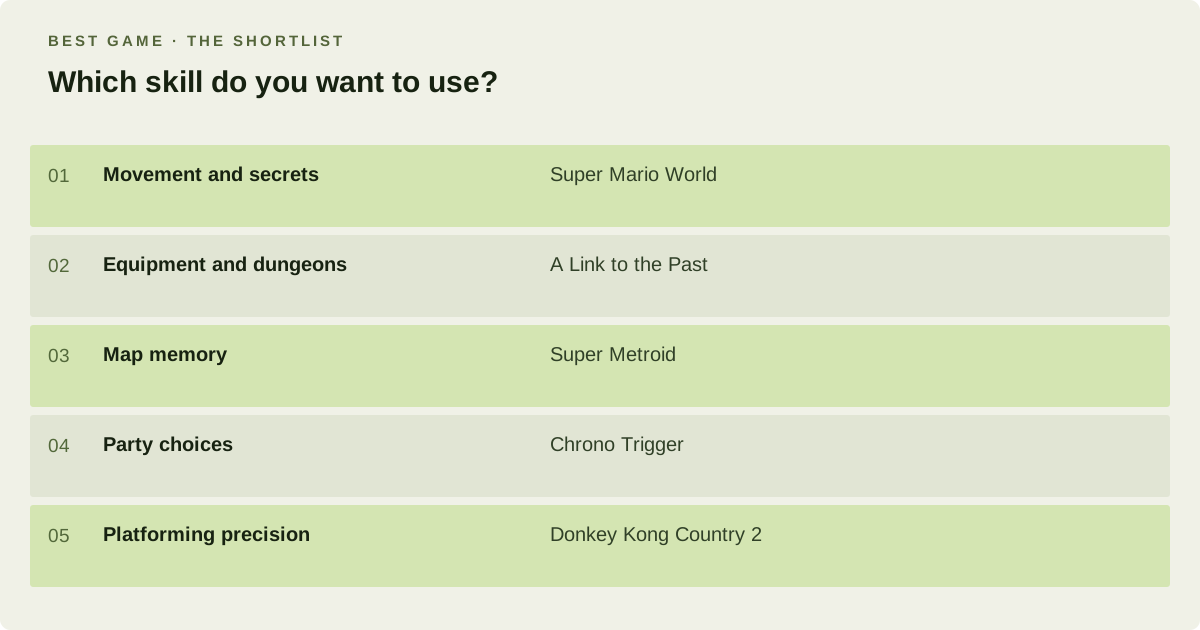
Which skill do you want to use?. Comparison by play preference, not a numerical score.
How to choose without buying twice
Start with Mario World for a clear, immediate platforming language and room to explore. Diddy’s Kong Quest is better when you actively want a tougher sequence of precision challenges. A Link to the Past gives equipment and dungeons a visible structure, while Super Metroid expects more trust in environmental clues. Chrono Trigger is the choice when party relationships and story provide the motivation. If Metroid’s map is the attraction, metroidvania games develop that exploration structure in many different directions.
Original cartridges require suitable hardware and working saves where applicable; later official versions can provide convenient suspend functions or different presentation. Nintendo Classics includes a selected SNES catalogue, but that does not mean every game in this article is available through the service. Check the title and region before subscribing or buying another device. NES games provide an earlier, often stricter design baseline, while GBA games adapt many similar ideas to handheld play. N64 games show how Nintendo approached the move into 3D.