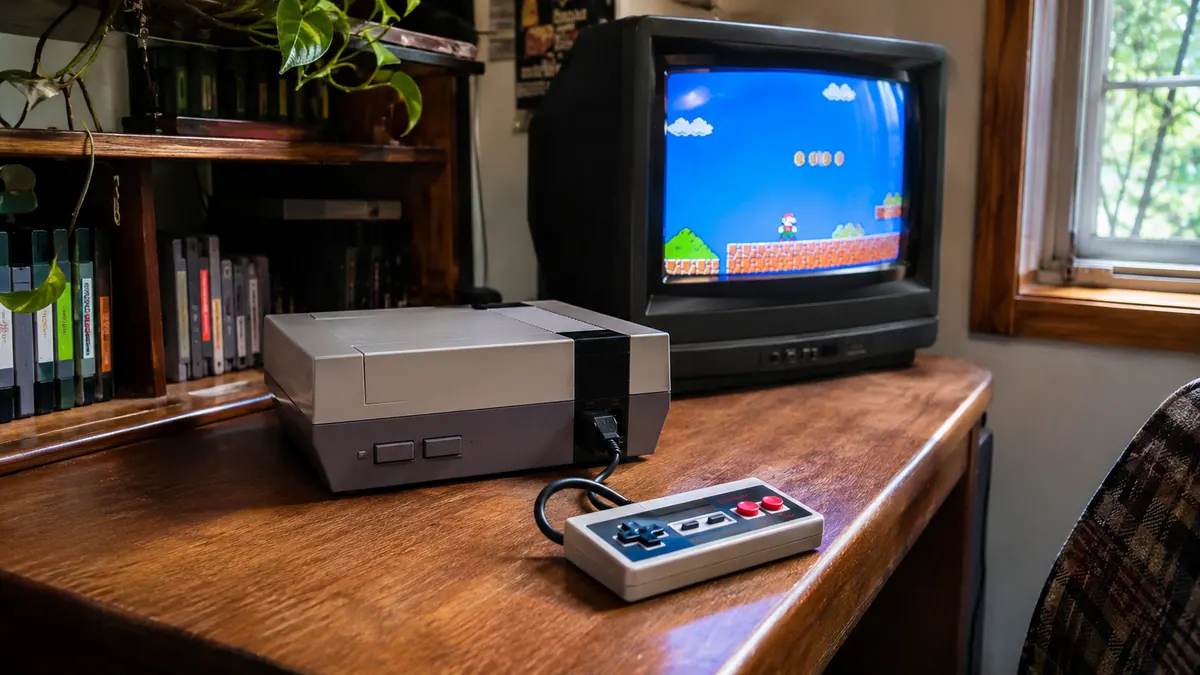
NES games can be immediately understandable without being easy to finish. A useful first choice makes its central idea clear: Mario’s movement, Mega Man’s weapon choices or Kirby’s copied abilities. Other classics ask for more patience with hidden information, limited resources and repeated attempts. These five recommendations cover both approaches. Choose according to the kind of challenge you enjoy, and separate the game’s original rules from any conveniences supplied by a modern official reissue.
NES starting points and their tradeoffs
- Super Mario Bros. 3: A world map and varied suits give familiar platforming a stronger sense of possibility. Stages frequently introduce a clear idea and move on before exhausting it, making individual levels satisfying even when you do not finish an entire world. The original cartridge lacks modern save conveniences; reissue suspend features change practical session planning.
- The Legend of Zelda: An open overworld makes curiosity a useful form of progress. Discovering a cave, an item or the route to another dungeon can feel like building your own understanding of a place rather than following an explicit mission list. Secrets and limited guidance can be obscure; keeping notes is helpful.
- Mega Man 2: Choosing a stage order and turning defeated bosses’ weapons into new tools gives action a strategic layer. Learning enemy patterns and where a weapon helps makes repeated attempts more purposeful than simply hoping to react faster. Boss weaknesses do not remove difficult platforming or the need to manage weapon energy.
- Kirby’s Adventure: Copying enemy abilities creates variety within an inviting platforming framework. Floating offers newcomers room to recover from mistakes, while secrets and changing powers give experienced players reasons to inspect more than the simplest path forward. It is gentler than the other action picks, although late sections still require attention.
- Castlevania III: Dracula’s Curse: Deliberate movement makes enemy placement and jump timing meaningful. Branching routes and recruitable companions add decisions to a demanding action structure, rewarding players who enjoy learning a stage’s rhythm and planning before committing to an attack. Regional versions differ, and the challenge can be unforgiving.
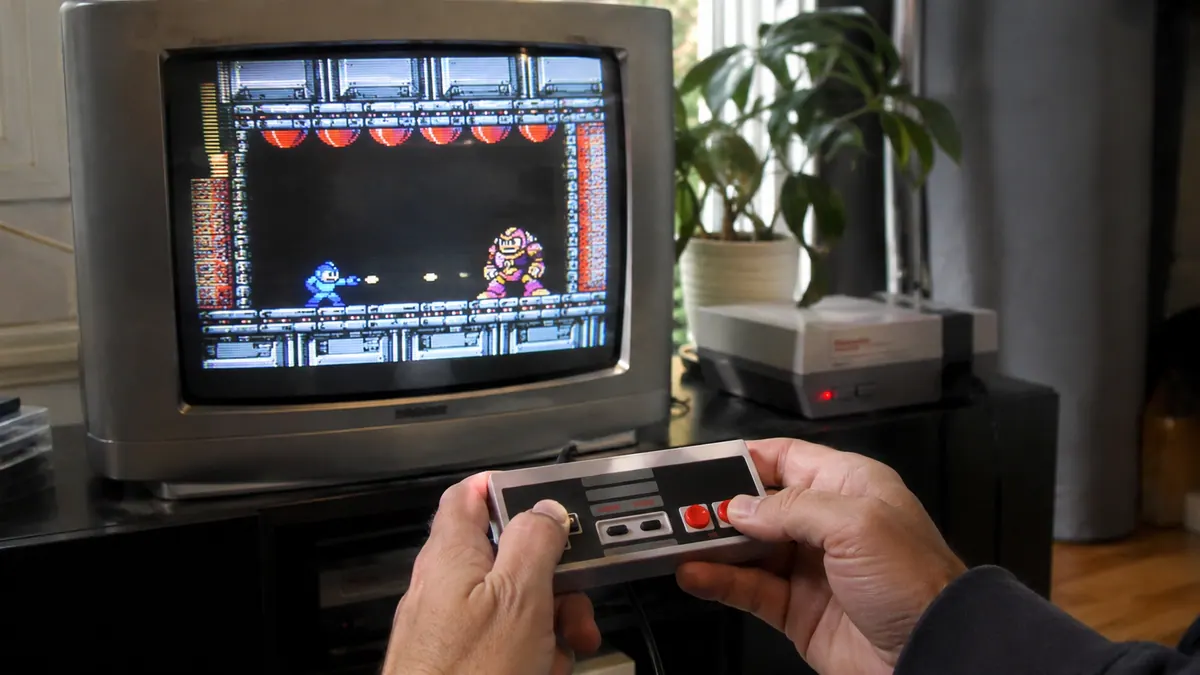
AI-generated editorial photograph with a fictional game display; not an official screenshot.
Compare the games at a glance
| Game | Best fit | Main consideration |
|---|---|---|
| Super Mario Bros. 3 | Inventive, readable platforming | Original saving limitations |
| The Legend of Zelda | Self-directed exploration | Hidden information and sparse direction |
| Mega Man 2 | Action with weapon planning | Demanding stages and resources |
| Kirby’s Adventure | An approachable retro introduction | Lower initial challenge |
| Castlevania III: Dracula’s Curse | Measured, demanding action | High difficulty and version differences |
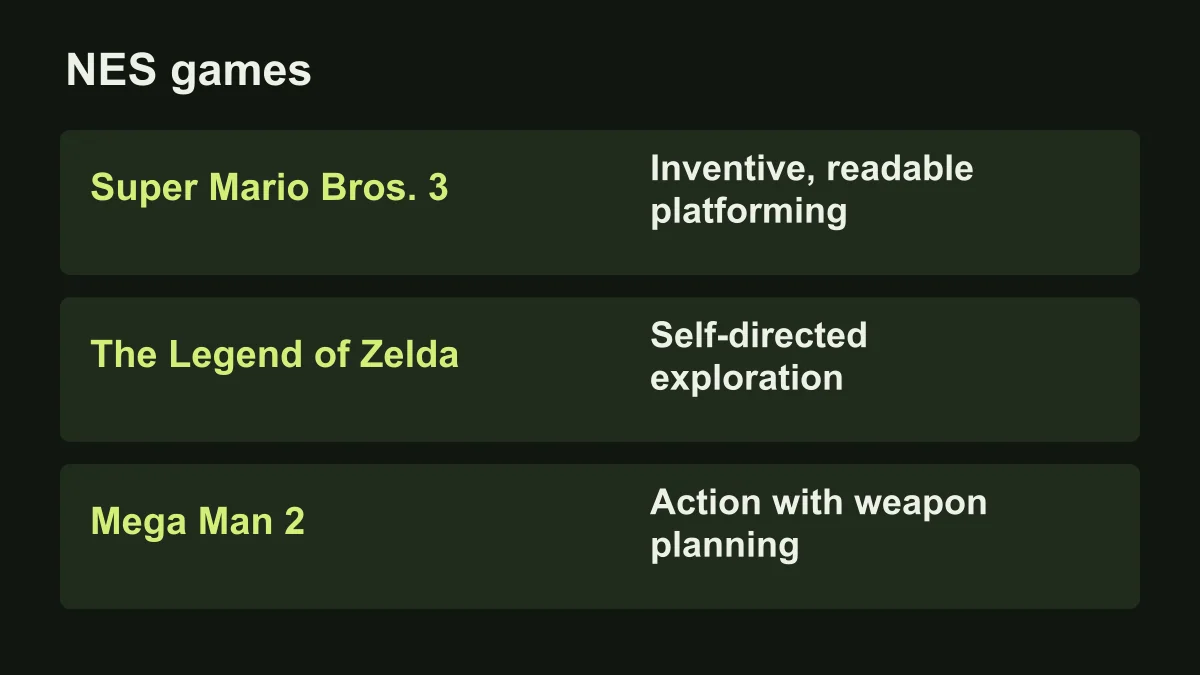
Editorial comparison based on the article; not a numerical ranking.
How to choose without buying twice
Mario 3 is the strongest general starting point because its ideas are easy to read while its optional depth remains substantial. Kirby is more comfortable when a newcomer wants to explore without constant punishment. Mega Man suits players who like experimenting with tools between attempts. Castlevania asks for patience and deliberate execution, while Zelda replaces a straightforward route with investigation. For Zelda games, that original openness is an interesting starting point, but later entries offer clearer direction if hidden information becomes frustrating.
Modern official collections can make these games easier to fit into an evening through suspend or rewind options. Those are features of a particular release or service, not capabilities of every original cartridge. Nintendo’s NES catalogue and standalone collections differ, so verify the exact game and regional version rather than assuming one subscription includes all five. SNES games offer later developments of these 2D ideas; GBA games provide portable alternatives. The best first retro game is one you enjoy learning, not necessarily the one with the harshest reputation.